Nous sommes responsables de la construction-----nous sommes responsables de la fabrication-----nous sommes responsables de la formation

A poinçonneuse à tourelle indexes a rotating disk of punches and dies over a sheet, striking one station at a time to cut holes, notches, louvers, or embossed shapes. For hole-dense parts — vent grilles, perforated panels, switchgear doors — it beats laser cutting on cost per part, even though a laser wins on cut geometry freedom.
Two turrets face each other — punches on top, matching dies below. A sheet sits clamped between them on a worktable, and a servo or mechanical drive indexes both turrets in sync so the right punch-and-die pair lines up under the striker. The striker hits, the sheet advances, the turret rotates again. Repeat a few hundred times a minute and you have a finished panel of holes, louvers, or embossed ribs.
That’s the whole mechanism. What separates one turret punch press from another is how fast that indexing happens, how tightly it repeats, and how many stations are loaded and ready without a manual tool change.

STON builds both drive types, and the spec sheets show exactly where the difference shows up — not in accuracy, but in speed and running cost.
| Paramètres | Mechanical CNC Turret Punching Machine | Servo CNC Turret Punching Machine |
|---|---|---|
| Max turret speed | 30 rpm | 40 rpm |
| Machining accuracy | ±0.1 mm | ±0.1 mm |
| Max load capacity | 150 kg | 150 kg |
| Combined power consumption | ≤2 kW | Approx. 3–5 kW |
| Air source pressure | 0.55 MPa | 0.55 MPa |
| Alimentation électrique | 380 V ±5% | 380 V ±5% |
| External dimensions | 5200 × 5000 mm / 5500 × 2100 mm (X × Y × height) | 5200 × 5000 / 5500 / 6500 × 2230 mm |
| Drive mechanism | Proprietary flywheel system; dual-chain drive mold system | RTEX bus servo units; dual-chain drive with heat exchanger and oil cooler |
Positional accuracy is identical on paper (±0.1mm on both), which tells you the servo model isn’t buying precision — it’s buying throughput. A 40 rpm turret index rate versus 30 rpm compounds fast on high-hole-count parts, and the servo drive’s oil cooler and heat exchanger are there specifically to hold that higher cycle rate without thermal drift over a full shift. The trade-off is power draw: roughly double the combined consumption of the mechanical model.
Both drive types share a worm-gear hard-connection rotary station design with an internal copper shaft, and both use a dual-chain drive system on the mold indexing — STON’s spec sheets note this extends the chain-tensioning service interval to over a year on either machine, which matters more on the mechanical model since it has no servo feedback loop to compensate for chain stretch.
This is the comparison most buyers actually need, and it isn’t close to a universal answer.
Turret punch wins on:
Laser cutting wins on:

STON‘s turret tooling (documented on the SFL combined line) uses standard station classes — 16A, 11B, 3C, 2D, plus rotary workstations 1B and 1C — a naming convention shared across the industry’s 85-series long-guide tooling standard rather than a proprietary system. If a supplier’s spec sheet lists die types you don’t recognize against this naming, ask directly whether the tooling is interchangeable with 85-series standard punches — non-standard turret tooling locks you into a single supplier for every future die purchase.
The turret station count gets treated as the headline spec, and it’s the wrong one to lead with. A turret loaded with 40 stations you rarely use adds nothing over a 20-station turret matched to your actual part library — and it adds index time, since a mechanical or servo drive still has to rotate past unused stations to reach the next active one on some part programs.
The number that actually predicts your cycle time is turret index speed (30 rpm mechanical vs 40 rpm servo above) combined with your part’s hole count and pattern complexity — not raw station capacity. Before comparing station counts between suppliers, pull your actual part library and count how many distinct punch/die combinations you use across your top 20 SKUs. That number, not the turret’s theoretical maximum, is what should drive the tooling spec.
Most manufacturer sites present a turret punch press as a single spec block — tonnage, station count, and a stock photo — without separating what the mechanical and servo drive versions actually trade off against each other, or explaining how station count relates to real cycle time. The mechanical-vs-servo table above is meant to close that gap: same accuracy claim, different speed and power profile, and a buyer needs both numbers to size the right machine rather than defaulting to “the servo one” on the assumption that servo always means better.
Q: What’s the real difference between a mechanical and servo turret punch press?
A: Positional accuracy is the same on STON’s spec sheets (±0.1mm either way). The servo drive runs a faster turret index (40 rpm vs 30 rpm) and adds a heat exchanger and oil cooler to sustain that rate, at roughly double the power draw.
Q: Can a turret punch press replace laser cutting entirely?
A: No — it can’t cut free-form, non-repeating geometry without a matching die, and it can’t match a laser’s edge finish on thin, complex contours. It wins specifically on repetitive hole patterns and on forming operations (embossing, louvering) a laser can’t perform.
Q: How many turret stations do I actually need?
A: Fewer than most spec sheets lead with. Count the distinct punch/die shapes across your actual production part library rather than sizing to a theoretical maximum station count.
Q: Is a punch-laser combined machine worth it over a standalone turret punch press?
A: If your part family mixes hole-dense sections with free-form cuts in the same piece, yes — it removes a secondary clamping and alignment step. If your parts are purely repetitive holes, a standalone turret punch press is the simpler, lower-cost choice.
Q: What tooling standard should I check for compatibility? A: Ask whether the turret uses standard 85-series long-guide die stations. Proprietary die naming without that reference point can lock you into a single tooling supplier.
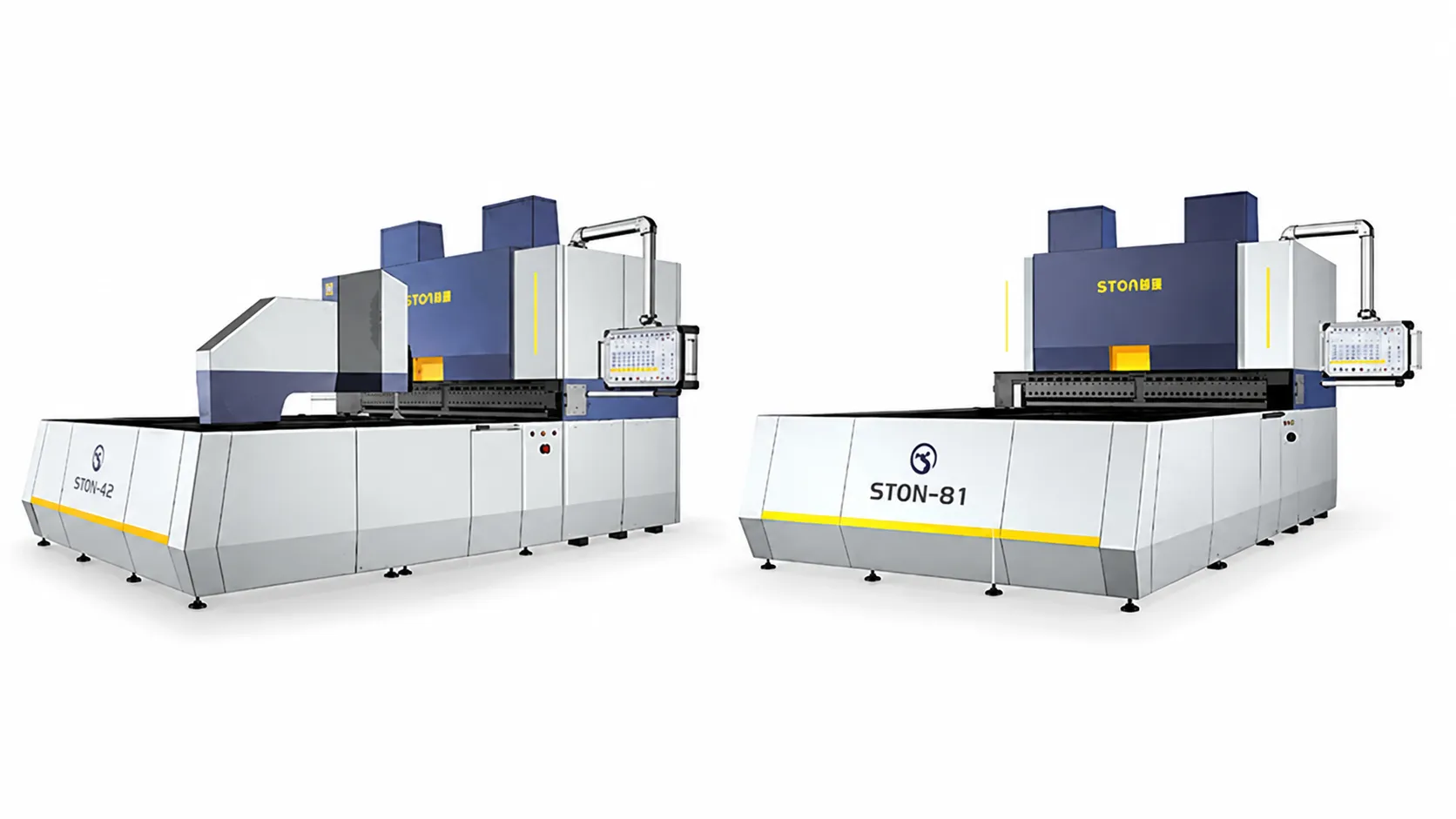

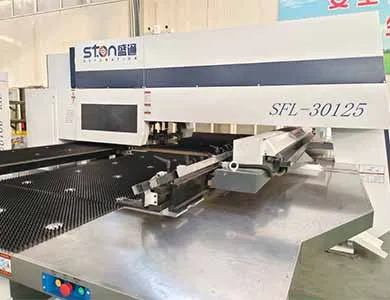
Que vous modernisiez une ligne existante ou que vous lanciez un nouveau projet, STON personnalisera une solution CNC pour votre production.


