Nous sommes responsables de la construction-----nous sommes responsables de la fabrication-----nous sommes responsables de la formation

An OEM sheet metal machine is customised at the mechanical and control level, not just in paint colour or badge. On a flexible bending center, the parts that actually change are axis drive count, tooling length, feeding method, and the software’s tool library. Everything else on the base platform stays the same across buyers.
That distinction matters because “customization” gets used loosely in equipment sourcing conversations. A trading company might mean “we can source whatever spec you send us.” A manufacturer means something narrower: within the mechanical envelope of a given platform, these specific subsystems can be swapped, upgraded, or added — and these cannot.
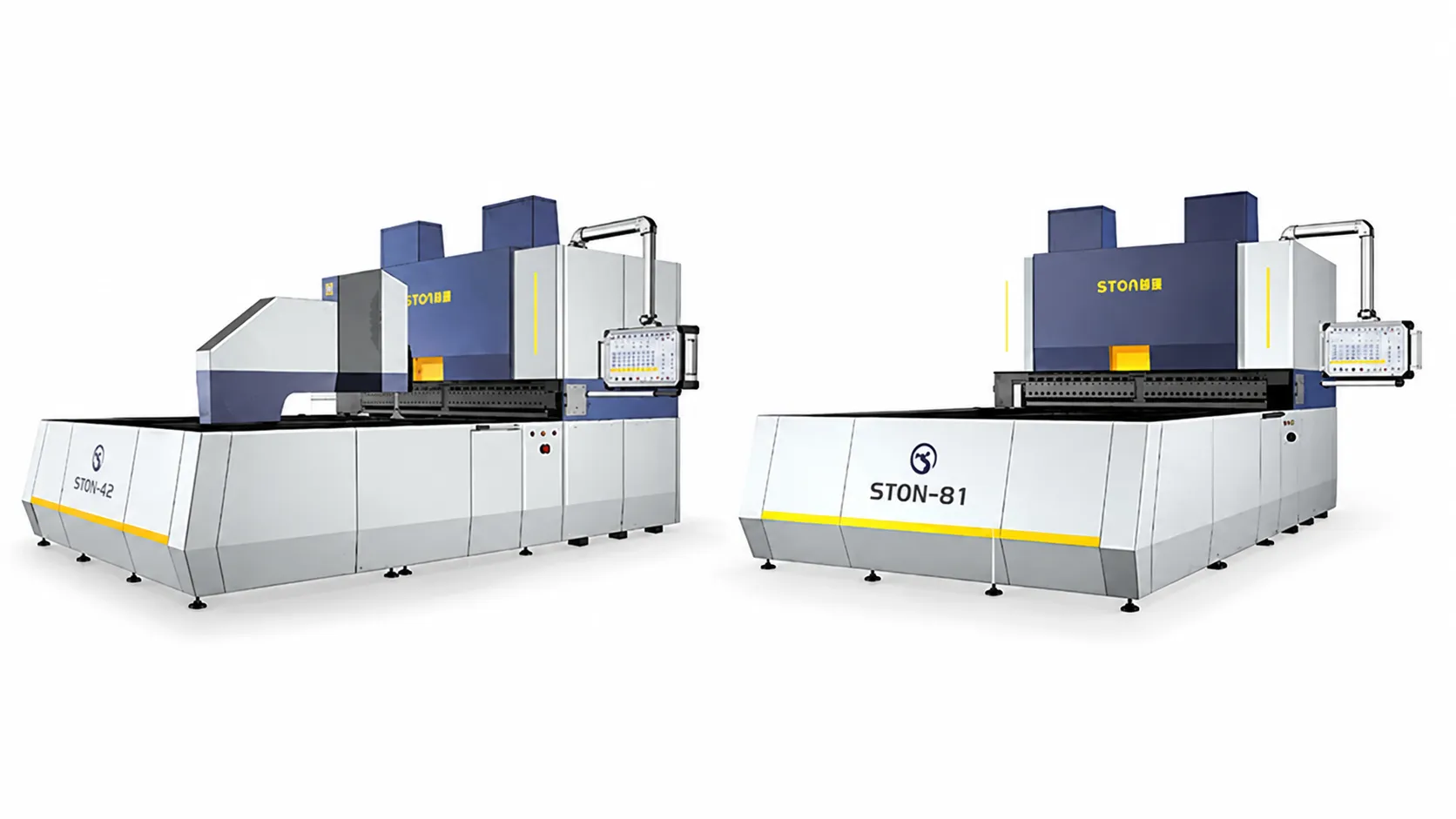
If a buyer needs a bending length outside the platform’s range — say, 3,200 mm on a machine that tops out at 2,800 mm — that’s not a customisation request, it’s a different model. Real customisation happens inside the envelope of a chassis size the manufacturer already builds. On STON’s Press Arm Type panel bender line, that envelope runs from the A (1000×1000 mm) frame up to the D+ (2800×1500 mm) frame, with five customisable subsystems layered on top of whichever frame fits the part.
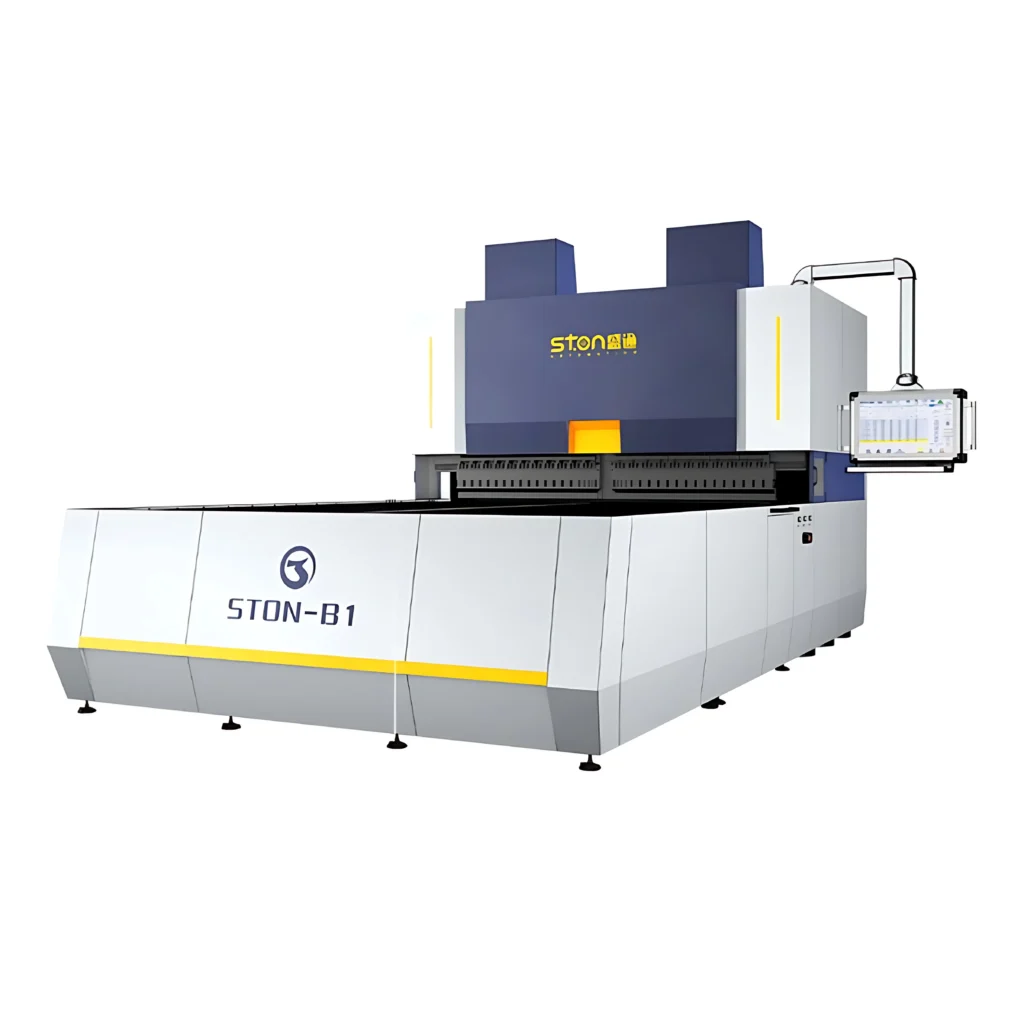
The standard servo axis count on Press Arm Type machines is 15. For workpieces that push toward the upper end of the thickness range, the W, X, and Z axes can each get an independent motor instead of sharing drive load — described in STON’s technical documentation as an upgrade “specifically designed for thick plates.” The frame itself is reinforced alongside the motor change; a buyer can’t bolt three-motor drive onto an unmodified bed and expect the same rigidity gain.
Base thickness capacity by bed type:
The three-motor upgrade extends working capacity beyond these baseline figures, but STON’s public documentation doesn’t publish a single universal ceiling — the achievable thickness depends on bend geometry and bed selection, which is why this option gets confirmed against a part drawing rather than quoted as a flat spec.
This is a feeding-side modification, not a bending-side one. It changes how the workpiece is gripped and lifted during the bend cycle, and it’s built for parts where standard clamping geometry doesn’t clear the fold. It’s paired with customised clamping hardware — magnetic grippers or specialty clamps — because C-axis lifting alone doesn’t solve a clearance problem if the gripper underneath it is generic.
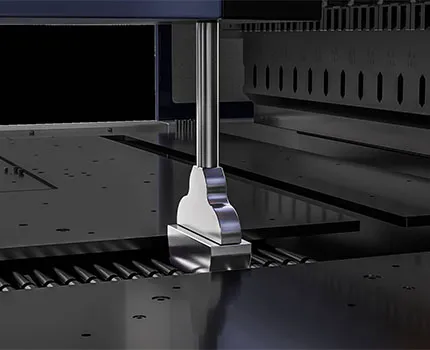
Upper, lower, or dual auxiliary knives extend the bending line‘s reach into local, small-scale folds that the main knife set can’t isolate cleanly. Blade length is customised to the workpiece, not selected from a fixed catalog of lengths. On vacuum-type machines specifically, auxiliary blades are forged from 42CrMo steel rather than the standard tool steel used elsewhere on the knife set — a material difference that affects tool life under repeated small-radius bending, not just geometry.
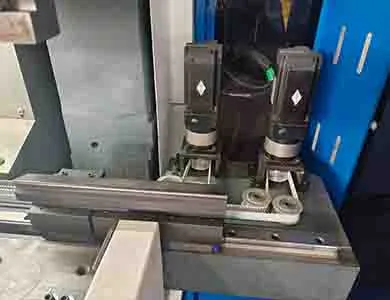
ATC is the option most often misunderstood as standard. It is not included on any base Press Arm Type configuration — it’s a “high-end customized upgrade,” in STON’s own product language, added specifically for shops running frequent workpiece switches within a shift. If your OEM order involves five SKUs a day with different bend profiles, ATC changes your changeover time. If you’re running one profile for a week at a time, it adds cost without changing throughput, and the more common tool-length customisation described above covers most single-product runs.
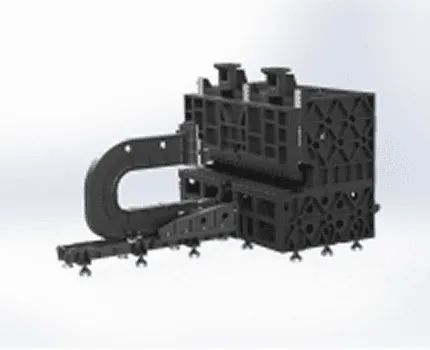
For parts near the platform’s minimum bendable dimension, accuracy tuning is done through fixture and clamping customisation rather than a separate machine tier. This is the option most likely to require a physical sample or detailed drawing before STON’s engineering team will confirm feasibility — small-part tolerance stacking behaves differently machine to machine, and no dealer should quote it sight unseen.
Not every OEM order benefits from stacking these options. A common misconception among first-time equipment buyers is that more customisation options equal a better machine. In practice, each addition — extra motors, ATC, non-standard clamping — adds mechanical complexity and a longer commissioning window. For a shop producing one or two stable part families at moderate thickness, the standard Press Arm Type configuration with grinding-screw spindle, closed-loop servo control, and standard auxiliary knife options already covers the accuracy range most cabinet, enclosure, and door-frame OEM work requires. Layer in a three-motor upgrade or ATC only when the part drawing or the SKU-switching frequency actually demands it.
| Modèle | Max Bending Size (mm) | Max Bending Height (mm) | Max Thickness (Full Bend) | Servo Axes | External Dimensions L×W×H (cm) |
|---|---|---|---|---|---|
| A (1000) Welding | 1000 × 1000 | 170 / 300 / 400 | CR 1.5 mm / SS 1.0 mm | 15 | 425 × 160 × 255 |
| B (1400) Casting | 1400 × 1250 | 170 / 300 / 400 | CR 2.0 mm / SS 1.2 mm | 15 | 450 × 206 × 290 |
| C (2000) Casting | 2000 × 1500 | 170 / 300 / 400 | CR 2.0 mm / SS 1.2 mm | 15 | 558 × 270 × 310 |
| D+ (2800) Casting | 2800 × 1500 | 170 / 300 / 400 | CR 2.0 mm / SS 1.2 mm | 15 | 630 × 338 × 310 |
Cast-iron beds carry a higher rated thickness than welded beds at the same footprint — a structural trade-off worth flagging before frame size is chosen on thickness alone.
This depends on whether the base frame has the ATC mounting provision designed in from the start. It is not a universal retrofit — confirm with the manufacturer’s engineering team before assuming an existing unit can be upgraded.
Not necessarily, but the W/X/Z three-motor upgrade is paired with frame reinforcement on the same bed type you selected. Moving from welded to cast-iron bed is a separate decision tied to your baseline thickness target.
No — it’s used wherever clamping geometry can’t clear the fold path, which includes some small, deep-drawn parts as well as large panels needing lift-assisted feeding.

Que vous modernisiez une ligne existante ou que vous lanciez un nouveau projet, STON personnalisera une solution CNC pour votre production.


