Wir sind verantwortlich für den Bau-----wir sind verantwortlich für die Herstellung-----wir sind verantwortlich für die Ausbildung

Poor bend accuracy can ruin good sheet metal parts. A door may not close. A cabinet may not fit. A panel may need rework. For industrial buyers, CNC panel benders offer a smarter way to improve precision, reduce labor cost, and automate repeatable bending work.
CNC-Schwenkbiegemaschinen are accurate because the machine clamps the sheet metal, controls the bend sequence with CNC software, and uses upper and lower bending tools to form repeatable angles. For many panel-shaped parts, a panel bender can deliver better repeatability than manual bending or a traditional press brake, especially in batch production.
Accuracy in CNC panel bending means the final part matches the drawing. The bend angle should be correct. The flange size should be stable. The panel should stay flat where it needs to stay flat. Holes, slots, and edges should still line up after the bend.
For a sheet metal fabricator, accuracy is not just a number on paper. It affects the whole product. If the bend is wrong, the next process becomes harder. Welding may need adjustment. Assembly may slow down. Customers may reject finished parts.
A Plattenbieger holds the metal sheet on a worktable. The clamp fixes the workpiece. Then the bending blade moves up or down to bend the edge. The CNC system controls the bending process, including bend angle, bend height, bend direction, and bend sequence.
Unlike a traditional press brake, the panel bender supports the sheet during bending. The operator does not need to hold a large panel by hand. This reduces movement, human error, and angle variation. Less shaking means better precision.
The basic process looks like this:
A panel bender uses controlled motion. That is why it can produce stable bends for cabinets, enclosures, appliance panels, HVAC covers, and other sheet metal parts.

Both a panel bender and a press brake can be accurate. The better choice depends on the part. A press brake is very flexible and can bend many shapes, thicknesses, and long parts. But it often depends more on the operator, tool setup, backgauge use, and part handling.
A panel bender is often more repeatable for thin sheet metal panels. The workpiece stays supported. The clamp holds the sheet. The CNC control manages each bend. For repeated panel parts, this can improve accuracy and repeatability.
A traditional press brake still has value. It is useful for thick parts, special angles, short jobs, and flexible metal fabrication. But for high-volume enclosure panels, doors, covers, and metal cabinets, panel benders excel.
CNC control is one of the biggest reasons modern panel benders are accurate. The machine does not guess. It follows a stored program. This program controls the bend sequence, blade movement, clamp action, and angle setting.
Automation also reduces human error. In manual bending, the operator must position the sheet, hold the part, choose the tool, follow the order, and check every bend. That takes skill. It also creates variation from person to person.
With CNC bending, the control system keeps the process more stable. The same program can run again tomorrow, next week, or next month. This is important for repeat orders.
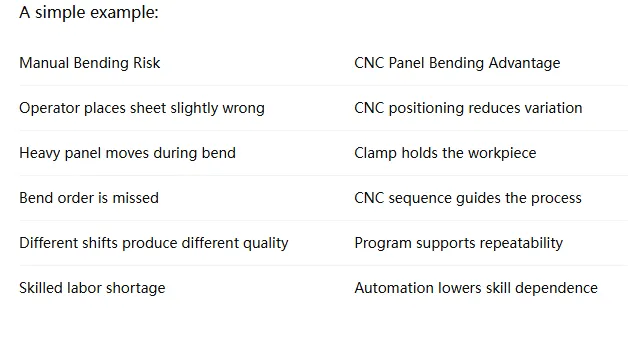
For factories facing labor cost pressure, automation is not only about speed. It also protects quality.

The tool system is the heart of any bending machine. In a panel bender, the bending tool, upper and lower bending blades, clamp, and blank holder all affect the final bend. If the tool is stable, the bend is more stable.
The clamp holds the metal sheet during bending. If the clamp is weak or uneven, the workpiece may move. Even a small movement can affect bend angle or flange size. A strong clamping system improves accuracy and repeatability.
Servo systems also matter. Servo movement helps the machine control position, speed, and pressure. When the servo system, CNC control, and bending tools work together, the machine can produce more stable bends.
Important tool-related points include:
For buyers, this means one thing: do not compare only machine size. Compare the full bending system.
Modern panel benders can deliver high-precision bending for suitable parts, especially when the material is stable and the part is designed for panel bending. The real accuracy depends on the machine model, sheet quality, tool condition, CNC program, and production environment.
In practical factory use, buyers should not only ask, “What is the accuracy?” They should ask, “Can this machine hold my required tolerance for my product, material, and production volume?” That is a better question.
For example, an electrical enclosure door may need stable flange height and angle. A stainless steel kitchen panel may need both accurate bend and clean surface. A metal furniture panel may need repeatable dimensions across long production runs.
A useful buyer test is sample bending. Send the supplier your drawing, material, and tolerance. Ask for a sample or bending simulation. This gives you real proof before investment.
Schwenkbiegemaschinen excel in repeated sheet metal panel work. They are strong in products that have multiple edges, rectangular shapes, box-like forms, clean surfaces, and high repeatability needs.
Common applications include:
These products often need several bends on one sheet of metal. Manual bending can be slow. A press brake can do the job, but the operator may need to rotate and support the part many times. A panel bender can automate more of the process.
For sheet metal fabrication factories, this improves productivity and helps reduce rework.

A panel bender improves productivity by reducing setup time, manual handling, and operator dependence. The machine can run a programmed bending cycle and repeat the same work with stable quality.
This is important because skilled bending operators are hard to find in many markets. A good operator can make a press brake very accurate. But if the factory relies only on skilled labor, production becomes risky when orders grow.
Panel benders help reduce labor cost in three ways:
For high-volume parts, the value is even stronger. Faster bending operations, better repeatability, and fewer rejected parts all support better return on investment.
Yes, panel benders can handle many complex bending jobs, especially panel-style parts with multiple flanges and bends. They are useful for complex geometries such as boxes, covers, trays, and enclosures.
However, no bending machine is perfect for every part. A panel bender has limits. It may not be the best choice for very thick plates, very small special profiles, or parts that need unusual tooling. A CNC press brake may still be better for some flexible jobs.
This is why industrial buyers should match the machine to the product. If most of your work is repeated panels, the panel bender is a strong option. If your work changes every day and includes thick or unusual parts, you may need both a panel bender and a press brake.

Before buying a panel bender, buyers should evaluate accuracy with real production data. Do not rely only on brochure claims. Ask practical questions.
Important questions include:
The best way to check accuracy is to test your own part. Provide the drawing, material, tolerance, and expected production volume. The supplier can then confirm whether the machine fits your production needs.
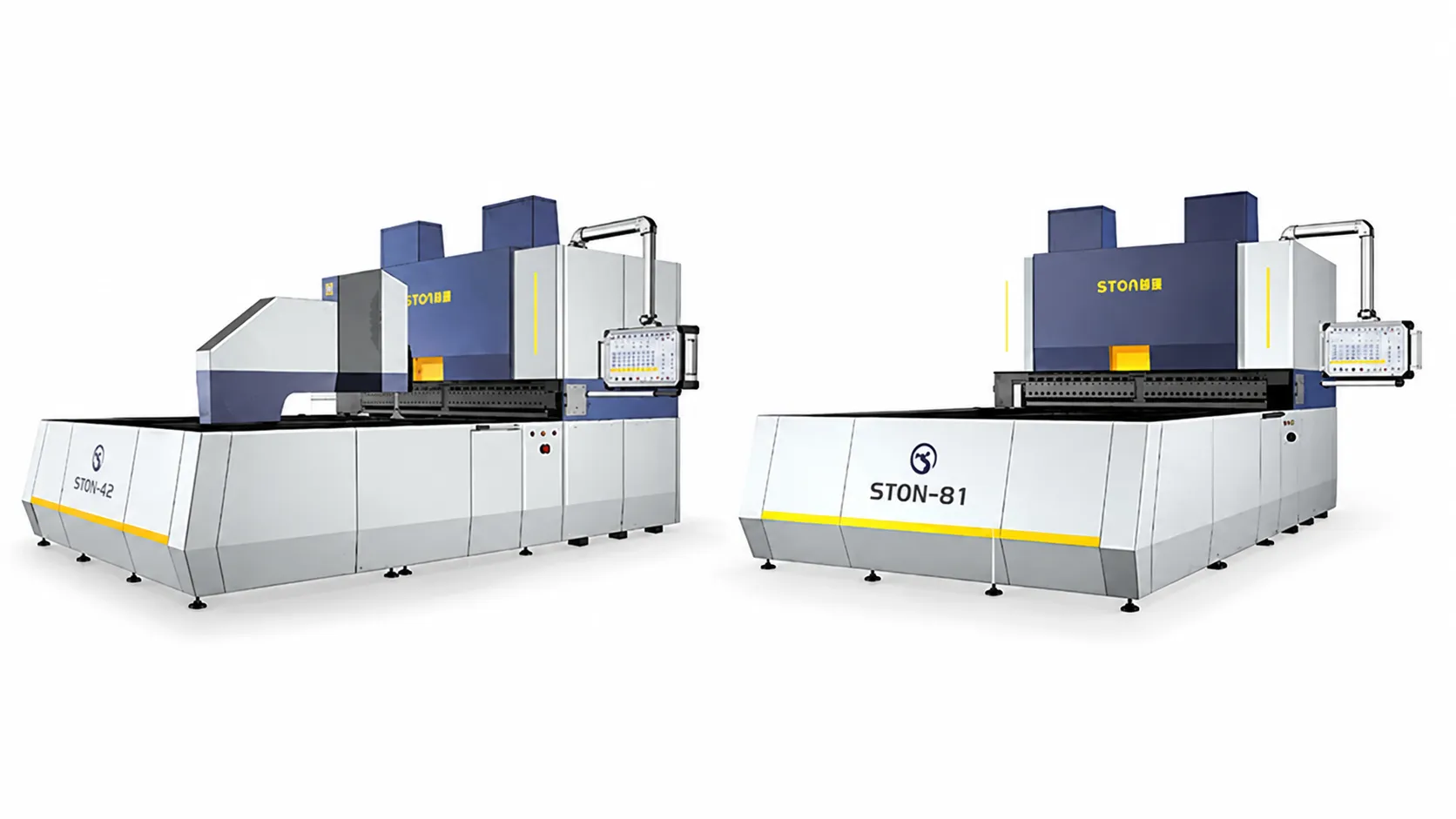
STON is a China-based CNC sheet metal machinery manufacturer. We provide panel benders, turret punch presses, press brakes, laser cutting units, and automated production lines. Our goal is to help global manufacturers improve processing efficiency, reduce labor costs, and build smarter factories.
STON CNC panel bending machines are designed for sheet metal fabricators, electrical cabinet factories, HVAC manufacturers, appliance producers, metal furniture makers, and machinery distributors. These buyers need precision, repeatability, training, stable equipment, and fast technical support.
Nützliche interne STON-Links:
When you send STON your part drawings, material information, thickness range, and output plan, our team can help evaluate whether a panel bender, press brake, or combined automation line is the right choice.
When you send STON your part drawings, material information, thickness range, and output plan, our team can help evaluate whether a panel bender, press brake, or combined automation line is the right choice.
CNC panel benders can provide high-precision bending for suitable sheet metal panel parts. Real accuracy depends on machine model, material type, thickness, part design, tool condition, and CNC settings.
For repeated thin sheet metal panels, panel benders often provide stronger repeatability because the sheet is supported and the bend sequence is controlled by CNC. Press brakes remain better for many thick, flexible, or special bending jobs.
The main factors are material thickness, material type, springback, tool condition, clamp stability, CNC control, servo movement, part design, and operator setup.
Ja. CNC-Schwenkbiegemaschinen can bend stainless steel when the thickness and part size match the machine capacity. Stainless steel usually needs careful control because it has more springback than mild steel.
Yes. Panel benders reduce labor cost by lowering manual handling, reducing dependence on highly skilled operators, and improving repeatability in repeated production runs.
Not always. A panel bender is excellent for repeated panels, enclosures, cabinets, and boxes. A press brake is still useful for thicker parts, special profiles, and flexible fabrication work.

Ganz gleich, ob Sie eine bestehende Anlage aufrüsten oder ein neues Projekt beginnen, STON bietet Ihnen eine maßgeschneiderte CNC-Lösung für Ihre Produktion.


