Wir sind verantwortlich für den Bau-----wir sind verantwortlich für die Herstellung-----wir sind verantwortlich für die Ausbildung

Revolverlochen gewinnt in der Regel bei Blechen mit vielen wiederholten Standardbohrungen; Laserschneiden gewinnt bei konturintensiven, kleinen Stückzahlen oder häufig wechselnden Teilen. Die entscheidende Variable ist die Lochdichte pro Teil, nicht die Gesamtkomplexität des Teils. Berechnen Sie die Zykluszeit pro Loch gegen die Werkzeugkosten und prüfen Sie dann die Dicke und Umformanforderungen, bevor Sie sich festlegen.
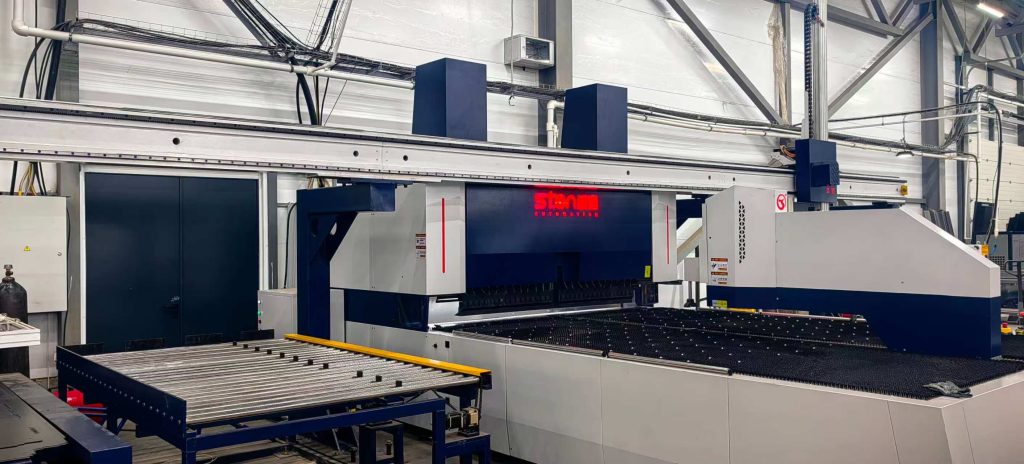
A Revolverstanzmaschine treibt einen gehärteten Stempel durch das Blech in eine passende Matrize. Das Metall versagt durch Scherung. Ein Werkzeughub, ein Merkmal, fertig – egal ob dieses Merkmal ein 6 mm rundes Loch, eine Jalousie oder eine Sicke ist.
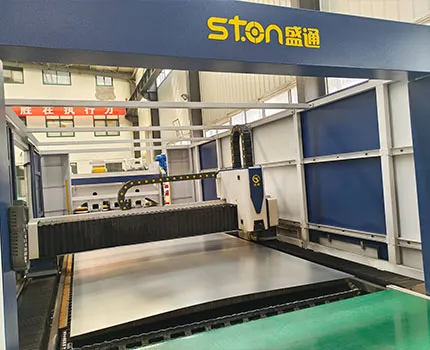
Ein Faserlaser schmilzt und verdampft eine Schnittfuge entlang einer programmierten Kontur, wobei Schneidgas die Schmelze entfernt. Nichts berührt das Blech. Der Kopf muss den gesamten Umfang jedes Merkmals abfahren, das er erzeugt.
Dieser einzelne Unterschied bestimmt fast alles andere in diesem Vergleich. Stanzen verursacht fixe Kosten pro Merkmal und es spielt keine Rolle, wie viele identische Merkmale folgen. Laser verursacht Kosten proportional zur Schnittlänge und es spielt keine Rolle, ob eine Form jemals zuvor geschnitten wurde.
| Dimension | CNC Turret Punch Press | Laserschneidanlage |
|---|---|---|
| Cost Driver | Strokes per part, including tool changes and hits | Total cutting length and pierce count |
| Best Geometry | Repeated standard holes, slots, louvers, and grids | Contours, curves, text, and one-off profiles |
| Typical Positioning Accuracy | ±0.1 mm based on STON SF/JT published machining accuracy | Determined by the drive system and laser source; contour-limited rather than tool-limited |
| Practical Thickness Range | Suitable for thin-to-medium sheet; capacity limited by punching tonnage | Wider processing range; STON laser units offer 1–6 kW options |
| Umformfähigkeit | Yes—louvers, countersinks, ribs, and tapping can be completed in the same setup | Nein |
| Edge Condition | Sheared edge with a burr side; deburring is often required | Fused edge without a burr side; secondary processing may not be required |
| Verbrauchsmaterialien | Punches, dies, strippers, and lubricant | Assist gas, nozzles, and protective lenses |
| Preparation for a New Part | New tooling may be required and can involve lead time | Program change only |
| Heat Effect on Sheet | Keine | Localised heat-affected zone |
| Noise and Vibration | Significant; influences guarding and foundation requirements | Low mechanical noise |
| Nesting Waste | Restricted by clamp dead zones and the tooling grid | Tight nesting and common-line cutting are possible |
The calculation is not complicated, and most fabricators already have the inputs sitting in their ERP.
The number that comes out is specific to your part mix. It is common for the same shop to find that its cabinet side panels belong on a punch press and its custom brackets belong on a laser, which is a useful conclusion rather than a frustrating one.

Punching force is finite. STON’s SFL punch-laser combined machine publishes 300 kN (30 t) and 400 kN (40 t) options in an “O”-type closed frame, and that tonnage sets a hard ceiling on the combination of thickness, material strength and punched perimeter you can attempt in one stroke. Stainless work-hardens and needs more force than cold-rolled steel at the same gauge; aluminium needs less but galls tooling if clearances are wrong.
Laser has no equivalent mechanical ceiling within its power band. STON’s laser units are offered from 1 kW to 6 kW, and the practical limit is cut quality and speed rather than a structural limit on the machine.
There is a second thickness effect people forget. Punching thin, springy stainless below about 1 mm can distort the sheet around dense hole patterns because the material is displaced rather than removed. If your product is a 0.8 mm stainless kitchen panel with a fine perforation grid, flatness after punching becomes a genuine engineering question rather than a footnote.

This is the part of the comparison that generic process guides tend to underplay. A turret punch does not only cut. In a single automatic sequence it can produce louvers for ventilation panels, extrusions for self-tapping screws, countersinks, embossed ribs for panel stiffness, and bridge lances.
Every one of those features on a laser-cut blank becomes a separate downstream operation: another setup, another transfer, another queue, another chance for a scratched panel. For an electrical cabinet maker or an HVAC panel producer whose parts carry louvers as standard, this alone can settle the choice regardless of what the cost-per-hole arithmetic says.
Punching’s real drawbacks are not “it can’t do curves.” They are:
Laser’s real drawbacks are:
On tolerance expectations, both processes should be specified against a stated standard rather than a vague “high precision” claim. General tolerance frameworks such as ISO 2768 give you and your customer a shared vocabulary for what an unmarked dimension is allowed to do.
The comparison stops being abstract once you look at configuration data. These figures are drawn from STON’s product tables for the machines in question.
Turret punch pressesA
| Parameter | SF Series (Servo Drive) | JT-Serie (Mechanisch) |
|---|---|---|
| Maximale Revolvergeschwindigkeit | 40 U/min | 30 U/min |
| Bearbeitungsgenauigkeit | ±0,1 mm | ±0,1 mm |
| Maximum Sheet Load | 150 kg | 150 kg |
| Kombinierte Leistungsaufnahme | Ca. 3–5 kW | ≤2 kW |
| Druck der Luftquelle | 0,55 MPa | 0,55 MPa |
| Stromversorgung | 380 V ±5% | 380 V ±5% |
| Table Structure | Brush and omnidirectional steel-ball composite | Brush and omnidirectional steel-ball composite |
| Overall Dimensions (X × Y × H) | 5200 × 5000 / 5500 / 6500 × 2230 mm | 5200 × 5000 / 5500 × 2100 mm |
The power figures are worth sitting with. A mechanical turret punch with a flywheel drive draws under 2 kW in combined consumption. A 6 kW fiber laser installation is planned around a 120 kVA supply. Over three shifts, that gap compounds into a number your finance team will notice.
Laserschneidanlagen
STON‘s double-platform laser cutting machine is offered in 3015, 4015, 4020, 6020 and 6025 formats. Floor space differs sharply by configuration: the single-table 3015 occupies roughly 4500 × 2600 mm, while the exchange-table version of the same working size occupies roughly 9000 × 3100 mm. The exchange table buys you loading of the next sheet during cutting; it costs you almost double the footprint. That trade is worth deciding deliberately rather than by default.
The combined option
STONs SFL-Serie servo punch-laser combined machine puts both processes on one bed with one clamping. Published configuration includes a die layout of 16A, 11B, 3C and 2D stations with two rotary stations (1B and 1C), an X-axis capacity of 2500 mm in a single position and up to 5000 mm with secondary positioning, Y-axis 1250/1500 mm, and repeatability quoted at ±0.01–0.02 mm from the double-chain rack-and-pinion drive. STON’s product data states the machine occupies roughly 40% less floor space than a separate punch press plus laser cutter, and removes the handling, second clamping and re-alignment time between the two operations.
STON does not publish list prices for these machines, because configuration, tooling package, laser power and automation change the figure substantially. Pricing is by quotation against your part drawings.
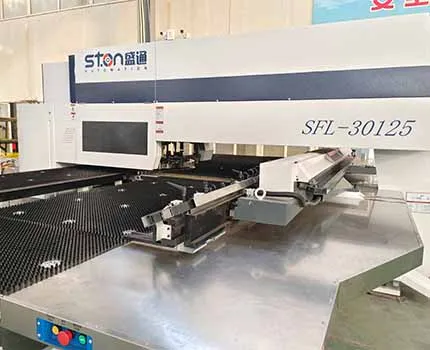
Compared with the split arrangement most fabricators run today — a standalone punch cell and a standalone laser cell, each with its own operator, its own queue and its own WIP buffer between them — an integrated approach changes the question from “which process” to “which process for which feature, within one part.”
That takes two forms. The first is the combined punch-laser machine above: punch the repeated holes and forms, laser the outer contour and the irregular cutouts, one clamping.
The second is a coil-fed line. STON’s uncoiling–leveling–laser cutting–punching–bending line runs from coil rather than pre-cut blanks, handling 0.5–2.0 mm material at 1000–1500 mm plate width with coil weight up to 10 T, and publishes leveling accuracy of ±1 mm/m² and diagonal accuracy of ≤1 mm per 2000 mm at a line speed of 0–12 m/min. For a factory producing one family of panels in volume — lockers, cabinet doors, ventilation panels — the material cost saving from buying coil instead of sheet is often larger than the process-choice saving being debated in the first place.
This only pays if your product mix is stable. A job shop quoting 400 different parts a month should not be reading this paragraph as advice.
“Laser is simply the more modern choice.” Process age is not a specification. A mechanical turret punch producing a 300-hole ventilation panel in one automatic cycle at under 2 kW is not an older way of doing something a laser does better; it is doing a different thing. The relevant question is what your parts look like, not which technology was invented last.
“We’ll decide after we buy, based on what work comes in.” Tooling is the trap here. A laser can accept a new part with a program change. A punch press may need a tool that does not yet exist in your inventory. If you buy a punch press without mapping your part families to a tooling package first, you will discover the gap on a live order. Map the tooling before the machine arrives, not after.
Q: Can a turret punch press cut an outer contour, or do I still need a laser or shear?
A: It can, by nibbling — overlapping strokes along the profile. The result has a scalloped edge and consumes a lot of strokes on a long perimeter. For straight-sided rectangular blanks it is perfectly practical. For curved or irregular outlines it is slow and the edge usually needs finishing, which is exactly the gap a punch-laser combined machine closes.
Q: Which process gives the better edge for a visible, painted panel?
A: Laser generally, because there is no burr side and no shear droop. Punched edges have a rollover on the entry side and a burr on the exit side, and on a visible edge that means deburring. If the punched features are internal holes hidden behind a cover, the edge condition rarely matters.
Q: How many tools should I budget for with a turret punch press?
A: Budget by part family, not by number. Take your top part families, list every distinct hole size, slot and form they require, and add the standard rounds and rectangles you will need for general work. Station layout matters too — a machine with dedicated rotary stations lets one tool cover slots at multiple angles instead of stocking one tool per angle.
Q: Does a fiber laser replace the punch press for thin stainless?
A: For pure cutting on thin stainless, laser avoids the distortion risk that dense punching creates in springy material. It does not replace forming. If those stainless panels need louvers or extrusions, you still need a punching capability somewhere in the process chain.
Q: What supply and utilities do I need to plan for?
A: For STON’s turret punch presses, 380 V ±5% and 0.55 MPa air. For laser cutting units, a 3 kW class installation is specified at ≤50 kVA with a 60 kVA supply recommended, and a 6 kW class at ≤100 kVA with 120 kVA recommended, plus assist gas supply and chiller provision. Confirm against the final configuration before you commission electrical work.
Q: How do I get a straight answer for my specific parts?
A: Send part drawings with material, thickness, feature list and annual volume. STON’s engineering team returns a process split and cycle-time estimate against specific machine configurations rather than a generic recommendation.
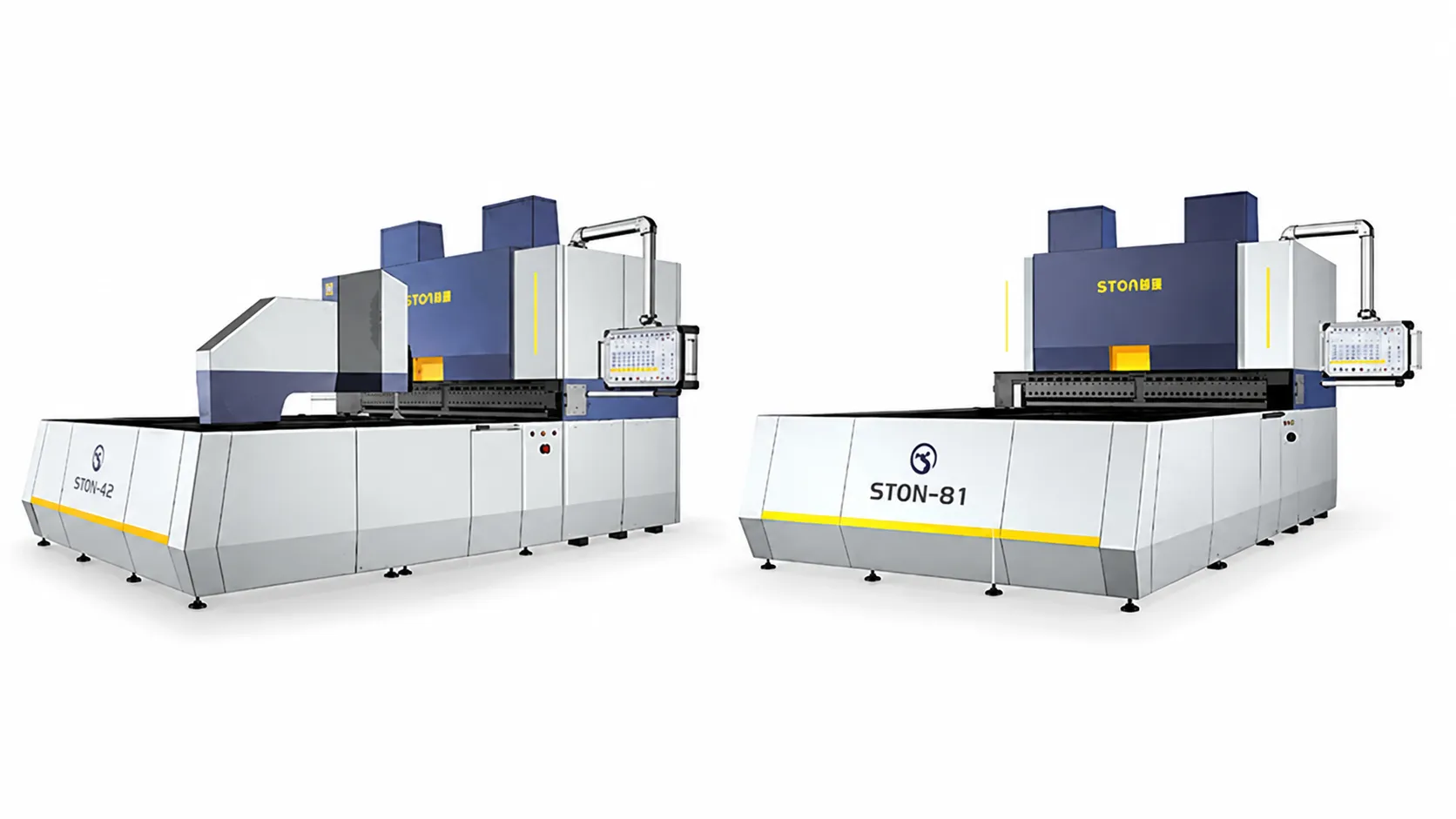

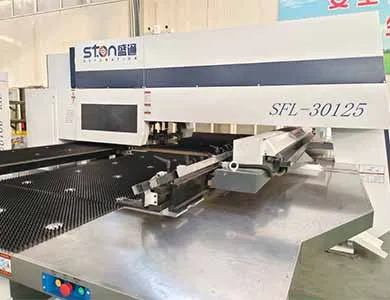
Ganz gleich, ob Sie eine bestehende Anlage aufrüsten oder ein neues Projekt beginnen, STON bietet Ihnen eine maßgeschneiderte CNC-Lösung für Ihre Produktion.


