We zijn verantwoordelijk voor het bouwen-----we zijn verantwoordelijk voor de productie-----we zijn verantwoordelijk voor de training

Kies een paneelbuiger wanneer één onderdeel veel korte flenzen heeft en de plaat binnen het diktebereik van de machine blijft: op STON‘s persarm-serie betekent dat koudgewalst staal tot 2,0 mm en roestvrij tot 1,2 mm op een gietijzeren bed. Kies een kantpers wanneer dikte, tonnage of onvoorspelbare geometrie het werk bepaalt.
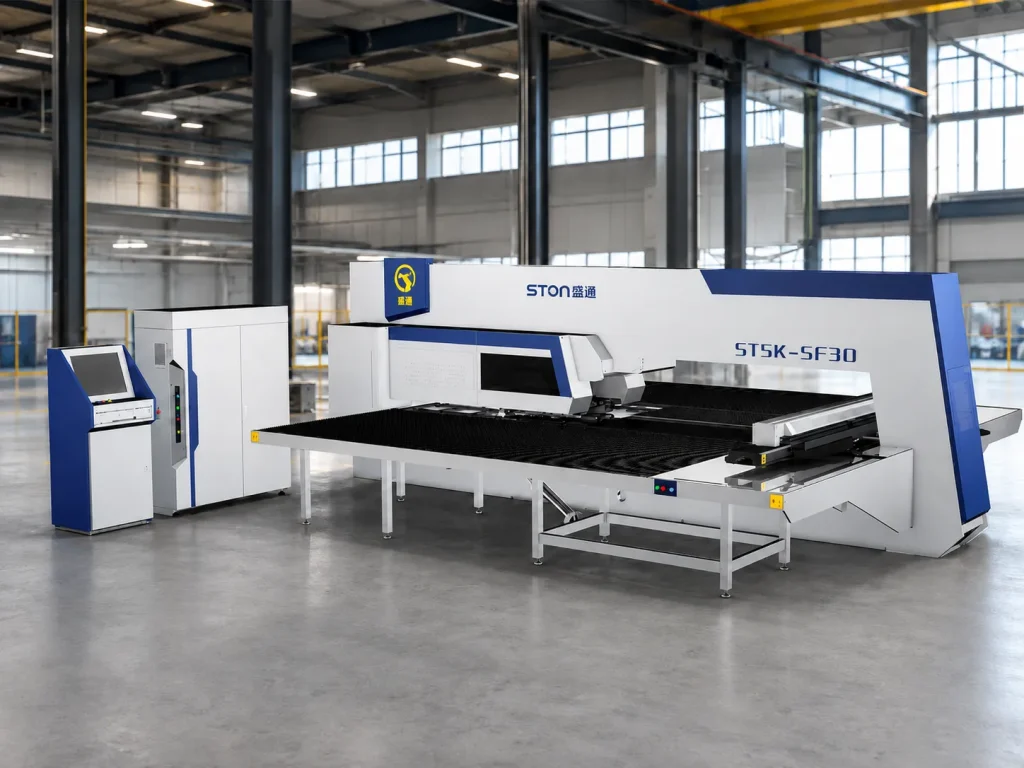
Bij een kantbank beweegt het werkstuk en blijft het gereedschap staan. Een operator tilt de plaat op, positioneert deze tegen de achteraanslag, trapt op het pedaal, draait het werkstuk om en herhaalt het proces. Vier flensen op een kastdeur betekent vier bewerkingscycli, en bij een paneel van 2,5 m betekent het twee personen die dit synchroon uitvoeren.
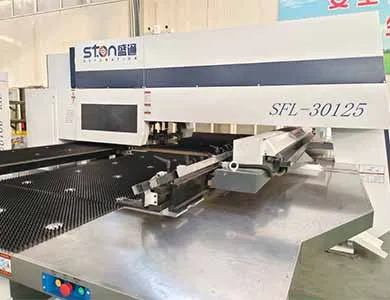
Bij een panelbuigmachine wordt het werkstuk eenmaal geklemd door een plaatklem en bewegen de buigbalken eromheen. Op- en neerwaartse buigingen gebeuren zonder het plaatwerk om te draaien. Dat enkele mechanische feit bepaalt vrijwel elk verschil verderop in het proces: arbeid per onderdeel, consistentie tussen het eerste stuk en het vijfhonderdste, krasrisico op voorgecoat roestvast staal en de benodigde vloerruimte voor handling in plaats van vormgeving.
Al het andere vloeit hieruit voort. Elke beperking ook.
| Beslissingsdimensie | CNC Paneelbuiger (STON Press-Arm Serie) | CNC Kantpers (STON PBS / PBE) |
|---|---|---|
| Vormgevingsprincipe | Plaathouder klemT eenmaal vast; buigmessen vormen elke rand | Stempel daalt in een V-matrijs en voltooit één buiging per slag |
| Behandeling per onderdeel | Eén keer laden en één keer lossen | Één behandelingscyclus per buiglijn |
| Max. dikte bij volledige buiging | Gelast bed: CR 1,5 mm / SS 1,0 mm Gegoten bed: CR 2,0 mm / SS 1,2 mm | Determined by tonnage: 63–320 t across the published range |
| Max. Working Length | 1000–2800 mm, depending on the model | 1500–4100 mm, depending on the model |
| Bend Height Range | Minimum: 5 mmMaximum options: 170 / 300 / 400 mm | Limited by tooling and open height rather than machine geometry |
| Minimum Four-Sided Inner Dimension | 140 × 190 mm | No equivalent constraint |
| Angle Range | 0–180° | Determined by tooling |
| Published Angle Accuracy | Approx. ±0.5°/m | Closed-loop grating scale with mechanical crowning compensation |
| Published Dimensional Accuracy | Approx. ±0.1 mm/mStraightness: approx. 0.2 mm/m | Depends on tooling, back-gauge programming, and the operator |
| Changeover Between Parts | Program recall; 15 servo axes reposition automatically | Tool change and back-gauge reprogramming |
| Operator Skill Dependency | Low after training | High and remains operator-dependent |
| Machine Weight | Lighter structure with a larger footprint | 4,500 kg for 63/1500 model to 19,000 kg for 320/4100 model |
Most machine-builder content on this topic argues one direction and stops. Compared with the general-purpose bending packages usually quoted against a paneelbuiger, the panel bender genuinely does win on enclosure-type work — and there are four situations where recommending one would be wrong.
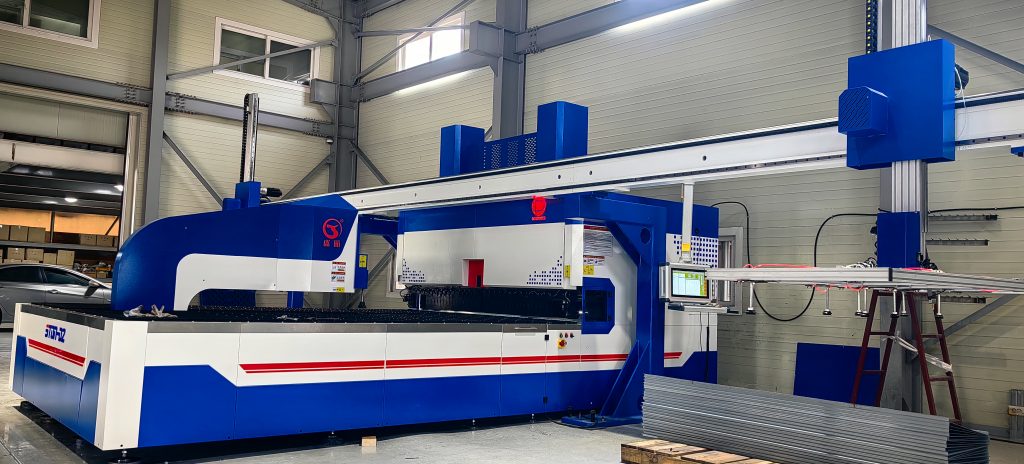
Plants upgrading from manual bending often frame this as replacement. In practice almost nobody scraps their press brakes when a panel bender arrives. The press brake keeps the prototypes, the repair parts, the thick brackets, the odd trapezoid nobody drew properly, and the remake when a customer changes a flange three days before shipment. What changes is the ratio: the panel bender absorbs the repeating 70–80% of enclosure volume, and the press brake stops being the bottleneck for everything else.
Budget for both. Sequence them by which one is currently constraining output.
The press-arm series runs from A (1000 × 1000 mm forming size) through A+ (1200), B (1400 × 1250), B+ (1600 × 1250), C (2000 × 1500), D (2500 × 1500) to D+ (2800 × 1500). Every model in the standard configuration carries 15 servo axes.
Bed construction is the specification that changes the answer more than model size does:
Gebruikelijke werkparameters voor de hele serie: buighoek 0–180°, minimale buighoogte 5 mm, hoeknauwkeurigheid circa ±0,5°/m, rechtlijnigheid circa 0,2 mm/m, maatnauwkeurigheid circa ±0,1 mm/m. Nutsvoorzieningen zijn driefasig 380 V met een luchttoevoer van 0,6 MPa.
Voor werk met dikke platen binnen het plaatbereik kan de W-as worden voorzien van een aparte motor, of kunnen de W/X/Z-assen worden geüpgraded naar een driemotorige aandrijving met een verdikte constructie. Hulpmessen — boven, onder of beide — kunnen worden gespecificeerd en op lengte worden gesneden voor gelokaliseerde korte buigingen op een onderdeel. Wanneer een werkstuk tijdens het vormen moet worden opgetild, worden een C-as hefconfiguratie en aangepaste klemming vóór de bouw gedefinieerd, niet erna.
Rechte randen, bogen en verschuivingen vallen net buiten deze familie. Die horen thuis op de flexibele randbuigmachine, die vormt tot een maximale buighoogte van 100 mm met een minimum van 4 mm, in maten 1200, 1600 en 2000.
Dit is het onderdeel dat Europese en Midden-Oosterse kopers laat in een project verrast.
Een kantpers is een machine met open gereedschap met een bewegende balk en handen van een operator dicht bij de matrijslijn. Onder de EU-machinerichtlijn 2006/42/EG zijn aanwezigheidsdetectie en veilige besturingsarchitectuur geen optionele extra's. EN 12622 behandelt specifiek de veiligheid van hydraulische kantpersen, EN ISO 16092 de bredere persfamilie, en EN ISO 13849-1 het vereiste prestatieniveau van het veiligheidsbesturingssysteem. STON‘s press brakes ship with a laser protection device that stops the beam when the monitored zone is broken.
A panel bender is a different risk profile: the forming zone is enclosed, and the operator’s role is loading and unloading rather than positioning during the stroke. Guarding is fencing and interlocks rather than presence sensing at the tool line. It does not remove the CE obligation, but it changes what the risk assessment under EN ISO 12100 concludes, and it usually changes the insurance and operator-training picture too.
Ask any supplier which of these standards their declaration of conformity references. A vague “CE certified” answer is worth following up on.
Q: Can a panel bender fully replace our press brakes?
A: Not in any plant we have configured. It replaces the repeating enclosure volume. Prototypes, thick brackets, oversized single bends and last-minute remakes stay on the press brake. Plan the panel bender as the machine that unloads your press brakes, not as the one that retires them.
Q: What thickness can a panel bender actually handle?
A: On STON‘s press-arm series, 1.5 mm cold-rolled and 1.0 mm stainless with a welded bed, or 2.0 mm and 1.2 mm with a cast-iron bed, at full bend. Aluminium runs slightly higher. If your parts sit right at these numbers, request a forming trial on your own material rather than relying on the table, because temper and coating both affect the result.
Q: We make electrical cabinets. Which machine first?
A: Usually the panel bender, provided your doors and side panels stay within the thickness limits and above the 140 × 190 mm minimum. Cabinet work is the archetypal case: many short flanges, four sides, high repeat, and a surface finish that suffers from repeated manual handling.
Q: How much floor space does each need?
A: A press brake occupies less machine footprint but needs handling and staging space around it, plus room for a second operator on long parts. A panel bender occupies more of a fixed cell and less variable space. Compare total cell area, not machine dimensions on the drawing.
Q: What does either machine cost?
A: STON does not publish list prices for panel benders or press brakes, because both are configured per application — bed type, blade height, axis upgrades, tooling, automation interface. Request a quotation against your part drawings. Any supplier giving you a firm figure before seeing your geometry is quoting a catalogue machine, not your machine.
Q: Can we add automatic loading later?
A: Yes on both families. STON’s panel benders and press brakes retain a native loading and unloading interface compatible with most robot arms and gantry systems. Retrofitting is far easier when the interface exists from day one, so specify it at purchase even if you install the robot two years later.
Q: Which is easier to staff?
A: The panel bender, decisively. Press brake accuracy tracks operator experience, and experienced brake operators are hard to hire in most markets. A panel bender moves that skill into the program.
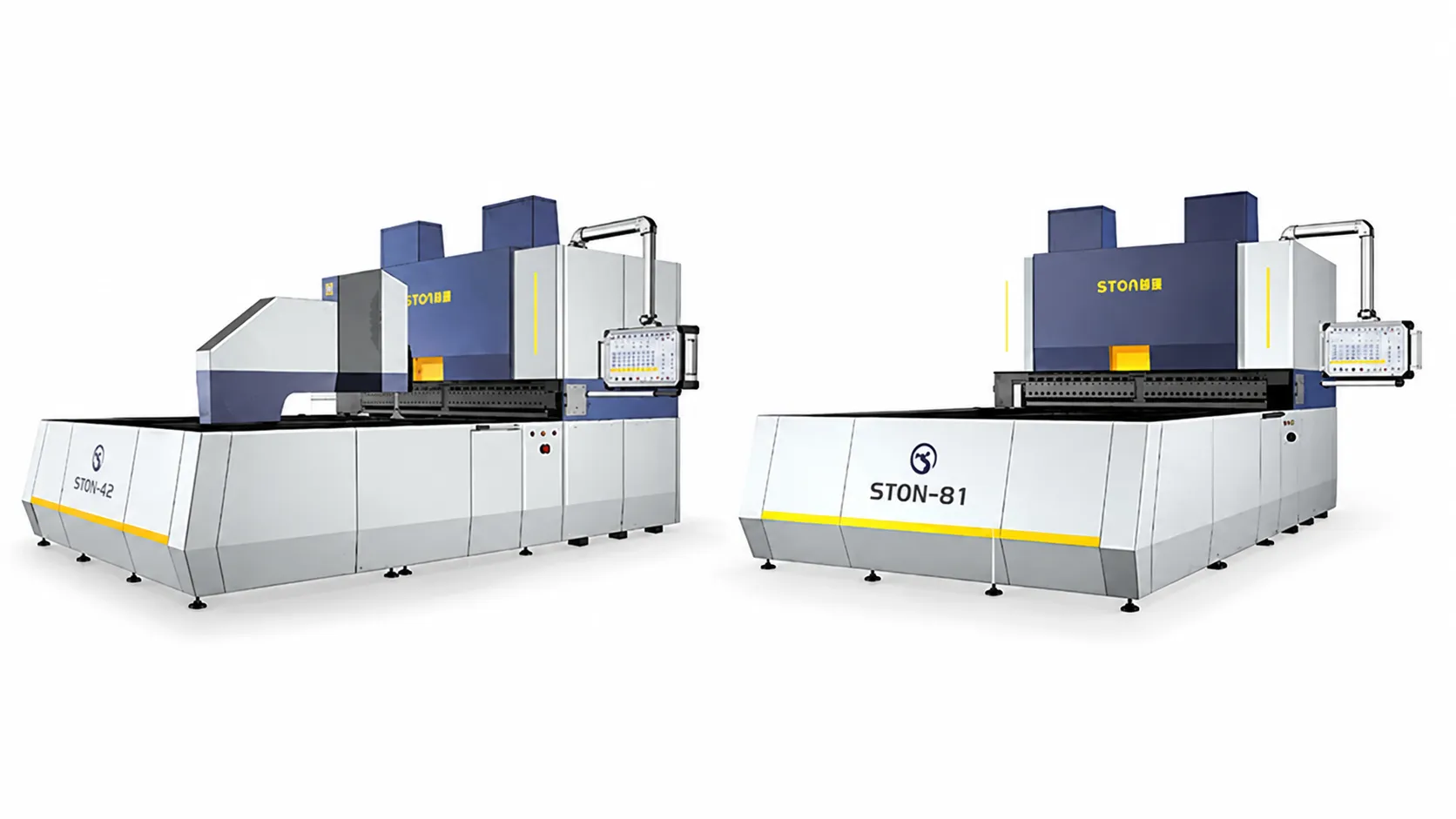

Of u nu een bestaande lijn upgradet of een nieuw project start, STON past een CNC oplossing aan voor uw productie.


