Somos responsables de la construcción-----somos responsables de la fabricación-----somos responsables de la formación

Most electrical cabinet doors and side panels run 1.0–2.0mm cold-rolled steel with two to four folded returns. That thickness and bend count sit at the edge of what a welded-frame dobladora de paneles can handle in one pass — the frame casting type and bend-height setting you pick decide whether the machine forms your part or forces you into a second operation.
Electrical and control cabinet parts share a narrow set of traits: flat rectangular blanks, folded edges (usually 90° returns for stiffness or EMI shielding), and cutouts for hinges, latches, or cable glands added before bending. The bending step itself is usually simple geometry repeated at high volume — which is exactly the workload panel benders were built for, and exactly why a mismatch between panel size, material thickness, and machine frame type shows up as scrap or rework rather than a slow cycle.
Two numbers from your own drawings matter more than any brochure spec: the largest panel dimension in the batch, and the thickest material you run across your full cabinet line (doors, sides, and any structural gussets). Everything below maps those two numbers onto a specific bending configuration.
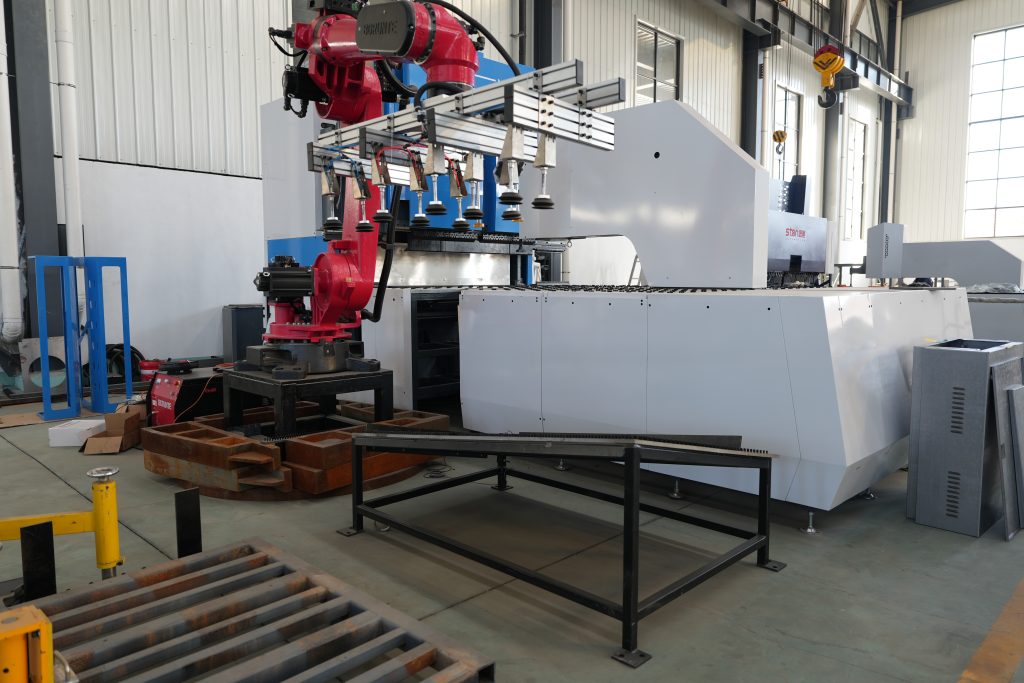
The table below is the STON Press Arm Type panel bender range, sized by maximum bending dimension. Bend height is fixed at three selectable stops — 170, 300, or 400mm — not continuously adjustable, so confirm your tallest cabinet side falls inside one of those stops before ordering.
| Modelo | Tamaño Máx. de Plegado (mm) | Altura máxima de curvado (mm) | Max. Bendable Thickness (Full Bend) | Ejes servo | Footprint L×W×H (cm) |
|---|---|---|---|---|---|
| A (1000), Welding | 1000 × 1000 | 170 / 300 / 400 | CR 1,5 mm / SS 1,0 mm | 15 | 425 × 160 × 255 |
| A+ (1200), Welding | 1200 × 1200 | 170 / 300 / 400 | CR 1,5 mm / SS 1,0 mm | 15 | 430 × 180 × 255 |
| B (1400), Welding | 1400 × 1250 | 170 / 300 / 400 | CR 1,5 mm / SS 1,0 mm | 15 | 540 × 198 × 298 |
| B (1400), Casting | 1400 × 1250 | 170 / 300 / 400 | CR 2,0 mm / SS 1,2 mm | 15 | 450 × 206 × 290 |
| B+ (1600), Welding | 1600 × 1250 | 170 / 300 / 400 | CR 1,5 mm / SS 1,0 mm | 15 | 560 × 218 × 290 |
| B+ (1600), Casting | 1600 × 1250 | 170 / 300 / 400 | CR 2,0 mm / SS 1,2 mm | 15 | 462 × 226 × 290 |
| C (2000), Welding | 2000 × 1500 | 170 / 300 / 400 | CR 1,5 mm / SS 1,0 mm | 15 | 596 × 258 × 298 |
| C (2000), Casting | 2000 × 1500 | 170 / 300 / 400 | CR 2,0 mm / SS 1,2 mm | 15 | 558 × 270 × 310 |
| D (2500), Welding | 2500 × 1500 | 170 / 300 / 400 | CR 1,5 mm / SS 1,0 mm | 15 | 596 × 308 × 298 |
| D (2500), Casting | 2500 × 1500 | 170 / 300 / 400 | CR 2,0 mm / SS 1,2 mm | 15 | 615 × 308 × 310 |
| D+ (2800), Welding | 2800 × 1500 | 170 / 300 / 400 | CR 1,5 mm / SS 1,0 mm | 15 | 626 × 338 × 298 |
| D+ (2800), Casting | 2800 × 1500 | 170 / 300 / 400 | CR 2,0 mm / SS 1,2 mm | 15 | 630 × 338 × 310 |
The frame material is the detail cabinet buyers most often skip past. Welded-frame units in this line cap out at 1.5mm CR / 1.0mm SS at full bend. Casting-frame units, available from the B model up, take 2.0mm CR / 1.2mm SS. If your cabinet spec calls for anything above 1.5mm cold-rolled — a common floor-standing switchgear panel spec — the welded frame isn’t rated for it, regardless of what the servo control claims it can drive. This isn’t a marginal difference: pushing 2.0mm material through a machine rated to 1.5mm doesn’t fail gracefully, it shows up as inconsistent angles on the far end of the fold.

Compared with a manually operated prensa plegadora — still the default for many smaller cabinet shops — a panel bender removes the repositioning step between folds, which is where most angle drift on multi-bend cabinet parts comes from. That advantage is real but conditional: it applies to repeat-run cabinet geometry, not one-off or highly irregular enclosures.
| Comparison Factor | Panel Bender (Press Arm Type) | Manual Press Brake |
|---|---|---|
| Dependencia de la Habilidad del Operador | Low — program-driven, with no manual repositioning between bends | High — angle consistency depends on operator technique |
| Best Fit | Repeat cabinet/enclosure production and parts requiring multiple bends | Low-volume, one-off production or non-standard bending sequences |
| Bend Height Flexibility | Fixed stops: 170 / 300 / 400 mm for this series | Continuously adjustable within tonnage and stroke limits |
| Upfront Cost | Más alto | Inferior |
| Changeover Between Part Types | Fast — primarily through program selection; tooling changes may be needed for different thicknesses or return sizes | Slower — requires manual tooling and backgauge adjustments |
Neither replaces the other outright. A cabinet shop running mixed one-off enclosure work alongside a standard door/panel product line often keeps a press brake for the odd jobs and puts the panel bender on the repeat runs.
STON’s product documentation does not list published price bands for the Press Arm Type panel bender series by model or configuration. Pricing depends on frame type, servo axis count, tooling, and any automation add-ons, so this is a request-a-quote item rather than a published range.
Only if it’s a casting-frame model rated to 2.0mm CR at full bend. A welded-frame unit capped at 1.5mm CR will handle the doors but not the thicker structural parts reliably.
Short local returns — cable-gland flanges, small stiffening lips — typically need the optional auxiliary knife (upper, lower, or both), sized to the return length on your drawing.
No — it’s set at three fixed stops (170/300/400mm). Confirm your tallest formed dimension fits one of these before ordering.
Not necessarily. The docking port for robotic or gantry loading is standard across the series, so automation can be added later without changing the base machine.
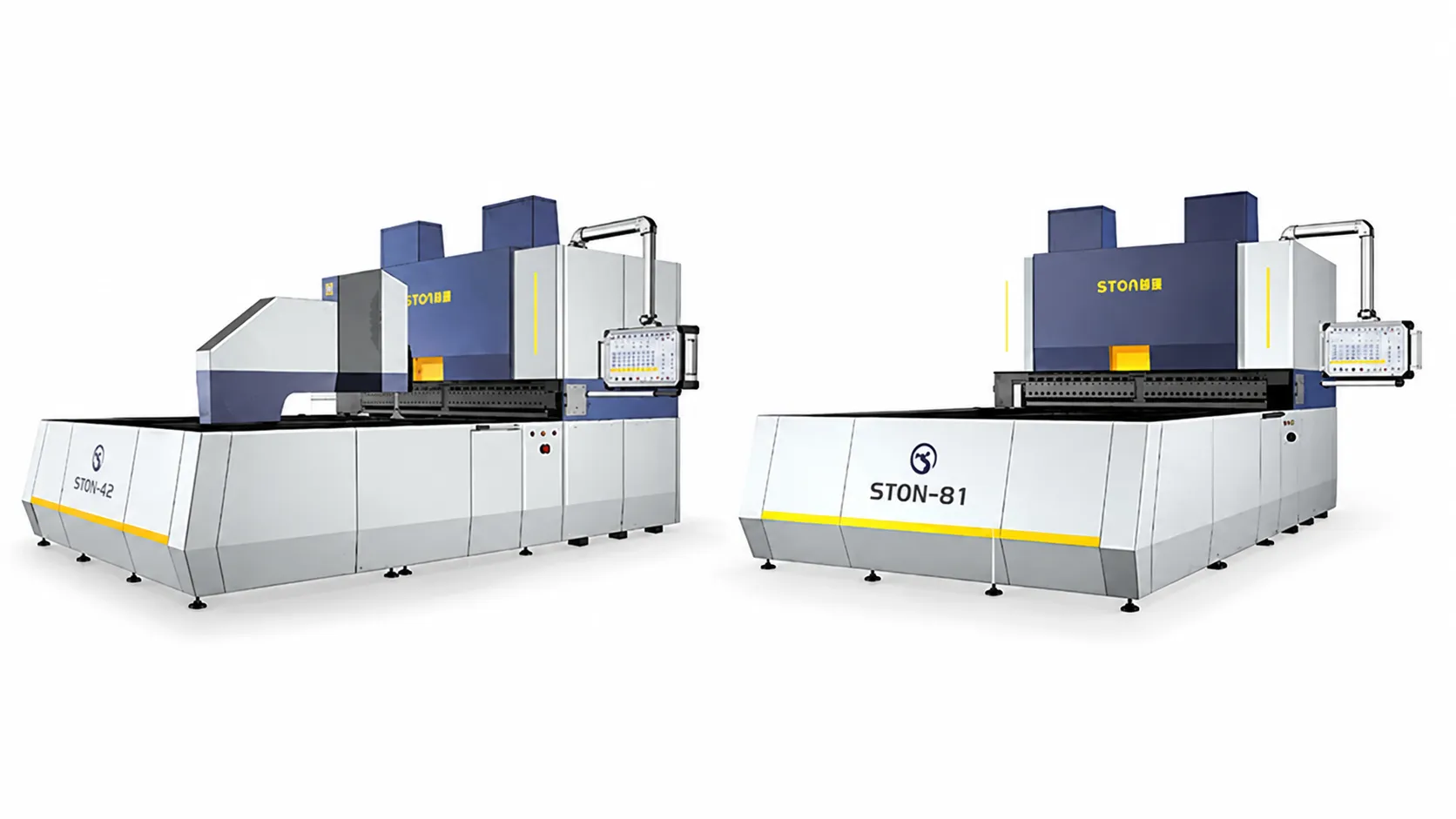

Tanto si está actualizando una línea existente como si está iniciando un nuevo proyecto, STON personalizará una solución CNC para su producción.


