우리는 건설을 책임집니다-----우리는 제조를 책임집니다-----우리는 교육을 책임집니다.

A sheet metal bending machine forms straight bends in flat sheet. Machines sold under that name use one of three mechanisms: a press brake pushes the sheet into a die, a folding machine swings a clamped flange upward, and a panel bender folds the edge with moving blades. Part thickness and geometry decide which one fits.
The term is an umbrella, and suppliers stretch it in different directions. In this article it means a machine that produces a straight bend line across a flat blank, the kind of bend you see on a cabinet door return, an enclosure side or a duct flange.
That excludes three families that often show up in the same search results:
If your parts are boxes, panels, trays, brackets or doors, you are choosing between the three machines below. Everything else is a different purchase.

Most buyer confusion comes from vocabulary, not engineering. “Press brake”, “folding machine”, “panel bender” and “bending centre” sound like four machines. Mechanically there are three, and one of the names is a marketing label for another.
| Name you hear | What it usually means | Bending principle | What moves | Common Chinese supplier term |
| Press brake | Punch-and-die bending press | Upper punch pushes the sheet into a V-die | The ram (and the operator handling the part) | Bending machine / CNC bending machine |
| Folding machine | Swing-beam (flap) folder | Sheet clamped flat; a hinged beam swings up and lifts the flange | The folding beam | Edge folding machine / Flexible edge folding machine |
| Panel bender | Automatic blade-type bender | Sheet clamped by a blank holder; upper and lower blades fold the edge | Blades and the sheet manipulator | Bending center / Flexible bending center |
| Bending centre | Usually the same machine as a panel bender | Same as panel bender | Same as panel bender | Bending center |
Two practical points follow from this table. First, when a Chinese supplier quotes a “bending machine” , you are almost always looking at a press brake. Second, “folding machine” is the slipperiest term of the four: some sellers use it for panel benders, some for manual box-and-pan folders, and some for CNC swing-beam folders. Ask which part of the machine moves during the bend, and the answer will tell you what you are actually being offered.
Press brake: the punch-and-die machine
A press brake holds a V-shaped die on its lower beam and a punch on the ram. The operator positions the blank against the back gauge, the ram descends, and the sheet is pressed into the die opening. Bend angle comes from how deep the punch travels; bend radius depends largely on the die opening.
Because force is delivered through tonnage, press brakes cover the widest thickness range of the three. The trade-off is handling. The part is lifted, flipped and repositioned for every bend, and each new profile may need a different punch and die set.
Folding machine: the swing-beam folder
A folding machine clamps the sheet flat between an upper clamping beam and the table, then rotates a hinged folding beam upward to lift the flange. The sheet itself stays on the table. That makes large, thin panels easier to manage than on a press brake, since nobody has to support an overhanging sheet while it rises with the bend.
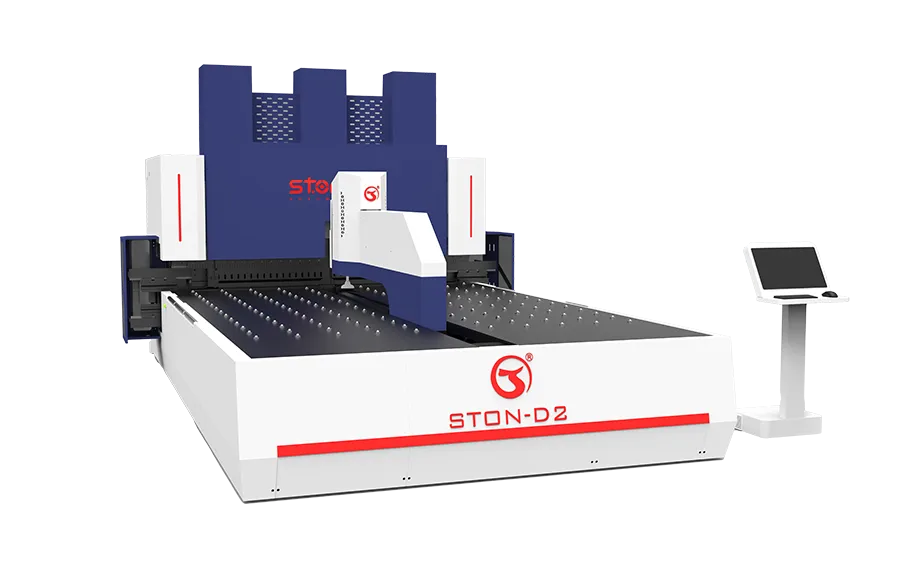
STON’s version of this machine (sold as the Metal Sheet Folding Machine, or flexible edge bender) adds CNC control of up to 25 axes and supports positive and negative bending, arcs, hems (“dead edges”) and offsets.
Panel bender and bending centre: one machine, two names
A panel bender clamps the sheet with a blank holder, then drives upper and lower bending blades around the clamped edge. A manipulator rotates and repositions the sheet between bends, so a four-sided box can be formed without an operator turning it by hand. Changing from one part number to another is mostly a program change, because the same blade set forms many different profiles.
“Bending centre” or “flexible bending centre” is the name many manufacturers, STON included, use for this class of machine. If a quotation says bending centre, read it as panel bender and compare it on the same terms.
The table compares the three mechanisms using STON’s own machines as reference points, so the numbers are real data sheet values rather than industry generalisations.
| 차원 | CNC 프레스 브레이크 (STON PBS / PBE) | Folding Machine (STON flexible edge bender) | CNC Panel Bender (STON press-arm / suction-cup) |
| How the bend is made | Punch presses sheet into V-die | Swing beam lifts clamped flange | Blades fold edge around blank holder |
| Force rating | 63 to 320 t (PBS range) | Not rated in tonnage | Rated by full-bend thickness |
| Thickness guidance | Set by tonnage, die opening and material; check the bending chart | Not published in STON spec sheet; confirm per material | Welded frame: CR 1.5 mm / SS 1.0 mm. Cast frame: CR 2.0 mm / SS 1.2 mm |
| Largest part (STON range) | Bending lengths to 4,100 mm (by model designation) | 2,000 × 1,500 mm | 2,800 × 1,500 mm (press-arm type) |
| Max flange / bending height | Limited by tooling and cylinder stroke (215 to 315 mm stroke) | 100 mm | 170 / 300 / 400 mm options |
| Smallest four-sided box (inner) | Depends on tooling clearance | 200 × 200 mm | 140 × 190 mm (suction-cup type) |
| Part handling | Operator moves part every bend, or a robot cell | Sheet stays on table; suction-cup loading | Manipulator turns sheet automatically |
| Changeover between part numbers | Often a tool change | Program change, same blank holder | Program change; optional automatic tool change |
| Automation route | Optional robot loading/unloading | Gantry robot or robotic arm interface; auto-loading model available | Native docking port for robotic arms and gantry systems |
| Where it struggles | Large thin panels, high-mix box work | Tall flanges, small boxes | Thick or high-strength plate, small or narrow parts |
Compared with a manually fed press brake cell, a panel bender removes the repeated lift-flip-reposition cycle on box-type parts. It gives up thickness capacity to do so, which is the single biggest reason shops end up owning both.
CNC 패널 벤더
STON builds two loading styles: the press-arm type for the full size range and the suction-cup (vacuum) type in the smaller sizes. Both use an all-electric servo closed-loop control system with bus control and 15 servo axes as standard.
Press-arm type: envelope and thickness by frame
| Max bending size (mm) | 프레임 | Max thickness at full bend | Outline L × W × H (cm) |
| 1000 × 1000 | Welded | CR 1.5 / SS 1.0 | 425 × 160 × 255 |
| 1200 × 1200 | Welded | CR 1.5 / SS 1.0 | 430 × 180 × 255 |
| 1400 × 1250 | Welded | CR 1.5 / SS 1.0 | 540 × 198 × 298 |
| 1400 × 1250 | Cast | CR 2.0 / SS 1.2 | 450 × 206 × 290 |
| 1600 × 1250 | Welded / Cast | CR 1.5 / SS 1.0 (welded); CR 2.0 / SS 1.2 (cast) | 560 × 218 × 290 / 462 × 226 × 290 |
| 2000 × 1500 | Welded / Cast | CR 1.5 / SS 1.0 (welded); CR 2.0 / SS 1.2 (cast) | 596 × 258 × 298 / 558 × 270 × 310 |
| 2500 × 1500 | Welded / Cast | CR 1.5 / SS 1.0 (welded); CR 2.0 / SS 1.2 (cast) | 596 × 308 × 298 / 615 × 308 × 310 |
| 2800 × 1500 | Welded / Cast | CR 1.5 / SS 1.0 (welded); CR 2.0 / SS 1.2 (cast) | 626 × 338 × 298 / 630 × 338 × 310 |
All press-arm sizes offer maximum bending heights of 170, 300 or 400 mm.
Suction-cup type: forming limits (1000 to 1600 sizes)
Configuration options worth knowing before you quote: upper and/or lower auxiliary knives for local short bends, C-axis lifting, magnetic grippers or custom clamping, automatic tool change, and a thick-plate model with a separate W-axis motor or a three-motor W/X/Z drive on a reinforced frame.

CNC 프레스 브레이크
STON offers two drive types. The PBS series is electro-hydraulic servo; the PBE series is a 4+1 axis pure-electric machine driven by a direct-drive servo motor with no hydraulic oil.
PBS electro-hydraulic series: selected parameters
| 모델 | Main motor (kW) | Cylinder stroke (mm) | Machine weight (kg) | Outline L/W/H (mm) |
| 63/1500 | 8.7 | 215 | 4,500 | 2000 / 1620 / 2470 |
| 63/2550 | 8.7 | 215 | 6,000 | 3150 / 1620 / 2470 |
| 100/3200 | 10.8 | 215 | 8,500 | 3720 / 1720 / 2550 |
| 150/4100 | 13.2 | 215 | 11,600 | 4680 / 1730 / 2600 |
| 220/4100 | 16.7 | 215 | 13,200 | 4730 / 1800 / 2670 |
| 250/4100 | 16.7 | 225 | 13,200 | 4730 / 1800 / 2670 |
| 320/4100 | 22 | 315 | 19,000 | 4760 / 2100 / 3250 |
The full range runs to 13 models. Standard equipment includes mechanical deflection compensation, a grating ruler with closed-loop feedback, a multi-axis CNC back gauge, a laser safety protection device and ESTUN servo drive. Controller choices are DELEM 53T, 58T, 66T or 69T, with an Italian ESA system as an option.
PBE pure-electric series shares the closed-loop grating ruler, mechanical compensation, multi-axis back gauge and laser protection, uses Siemens electrical components, and removes the hydraulic system entirely. Its model-by-model parameters are issued per quotation.
Work through these with one real drawing in hand. If you have a family of parts, run the thickest and the smallest separately.
1.Write down the material grade and the thickest gauge you bend regularly. If cold-rolled steel exceeds 2.0 mm or stainless exceeds 1.2 mm, a standard panel bender is out; start with a press brake. Below 1.5 mm CR / 1.0 mm SS, every option in this article is on the table.
2.Check the flat blank against the machine envelope. Panel bender sizes in STON’s range top out at 2,800 × 1,500 mm; folding machines at 2,000 × 1,500 mm. Longer single bends point to a press brake.
3.Measure the tallest flange. Over 100 mm rules out the folding machine; over 400 mm rules out the panel bender.
4.Find the smallest inner dimension of any four-sided box. Below 140 × 190 mm, a panel bender cannot close it; below 200 × 200 mm, the folding machine cannot. Small, deep boxes usually go to a press brake with suitable tooling.
5.Count part numbers per shift and average batch size. Many part numbers in small batches favour a panel bender, because changeover is a program call rather than a die swap. A few part numbers in long runs reduce that advantage.
6.Send the drawing for a sample bend. Specify the tolerance class on your drawing and ask for a measured sample, not a datasheet promise. This is the only step that turns a shortlist into a decision.
Is a folding machine the same as a press brake?
No. A press brake pushes the sheet into a die with a punch. A folding machine clamps the sheet flat and swings a beam upward to lift the flange. The sheet stays on the table during folding, which suits large, thin panels.
Is a bending centre different from a panel bender?
In most catalogues, including STON’s, “bending centre” and “flexible bending centre” refer to the panel bender: a machine that folds the sheet with upper and lower blades while a manipulator repositions it between bends.
What is the maximum thickness a panel bender can bend?
It depends on frame and material. STON press-arm panel benders are rated CR 1.5 mm / SS 1.0 mm at full bend with a welded frame, and CR 2.0 mm / SS 1.2 mm with a cast frame. A reinforced thick-plate model is available for heavier work.
Can a panel bender make negative bends and hems?
Panel benders form bends in both directions using upper and lower blades, across a 0 to 180° range on STON’s suction-cup type. For hems, arcs and offsets on large panels, STON’s folding machine lists them as standard processes.
Should I buy a pure-electric or electro-hydraulic press brake?
Electro-hydraulic models (STON PBS) cover tonnages up to 320 t. Pure-electric models (STON PBE) remove hydraulic oil and its maintenance. Choose by the tonnage your thickest part needs, then compare running costs.
Can these machines be automated later?
Yes. STON panel benders have a native docking port for robotic arms and gantry systems, the folding machine has a robot interface and an auto-loading model, and press brakes can be expanded with robotic loading and unloading.
기존 라인을 업그레이드하든 새 프로젝트를 시작하든 STON은 고객의 생산에 맞는 CNC 솔루션을 맞춤 제작합니다.