우리는 건설을 책임집니다-----우리는 제조를 책임집니다-----우리는 교육을 책임집니다.

A robotic bending cell pays for itself when labor savings and throughput gains exceed system cost within an acceptable window — typically under three years for most buyers. Whether that happens depends on batch size, part-mix variety, and local labor rates, not on the automation itself. Below is the arithmetic to check before ordering.
Search “robotic bending cell ROI” and most manufacturer pages converge on the same claim: payback somewhere between one and four years. None of them show the batch size, shift pattern, or labor rate behind that number. A shop running three shifts with a chronic operator shortage and a shop running one shift with stable staffing will land on wildly different paybacks with the identical machine — and a blanket “1–3 years” statement is true for neither in a useful way.
This is the gap worth closing before a purchase decision: not whether automation works, but at what batch size and part-mix profile it starts working for your operation specifically.
Most comparisons frame this as manual versus robotic. There’s a middle option that gets skipped, and it’s often the better fit.
| Configuration | What it is | Labor requirement | Best fit |
|---|---|---|---|
| Manned press brake | Operator loads, positions, and unloads every part manually | 1 operator per machine, full shift | Low volume, high part variety, one-off jobs |
| Panel bender + gantry/truss loading | CNC panel bender with a truss-type loader handling repetitive load/unload cycles | Operator monitors 2–3 machines instead of tending one | Mid-to-high volume, moderate variety, predictable panel geometry |
| Panel bender + robotic arm (full cell) | Panel bender paired with a 6-axis robotic arm for load, unload, and part-flip cycles | Operator oversight only, not continuous tending | High volume, stable product families, multi-shift or unattended runs |
이 패널 벤더 itself does the same forming job in all three rows. What changes is who — or what — is feeding it. This matters because the payback math for row 2 and row 3 are different questions, and vendors that only show “manual vs. fully robotic” skip the option that pays back fastest for a lot of mid-size shops.
To show the mechanics, here’s one filled-in example. Every number is a stated assumption for illustration only — not a published STON benchmark, not a customer result, and not representative of any specific market.
| Input | Assumed value |
|---|---|
| Incremental cost, robotic arm cell vs. manned brake | $85,000 |
| Operators displaced/reassigned | 1.5 (one full shift + partial second shift) |
| Fully loaded monthly labor cost per operator | $3,200 |
| Monthly parts volume | 12,000 |
| Manual defect rate | 2.5% |
| Automated defect rate | 0.6% |
| Average cost per scrapped part | $4.50 |
Monthly labor savings: 1.5 × $3,200 = $4,800 Monthly scrap savings: 12,000 × (2.5% − 0.6%) × $4.50 = $1,026 Monthly total benefit: $5,826
Payback = $85,000 ÷ $5,826 ≈ 14.6 months
Change the assumed volume to 4,000 parts/month instead of 12,000, and scrap savings drop to $342/month, pushing payback to roughly 16.5 months — a smaller swing than you’d expect, because labor savings dominate this particular scenario. Drop the operators-displaced figure to 0.5 (partial reassignment rather than full headcount reduction) and payback stretches past four years. That single variable — how many people the automation actually frees up, not just how fast it runs — is usually the one buyers underestimate.
Cycle-time comparisons on spec sheets assume the machine runs continuously. It doesn’t. Before comparing throughput numbers, apply an availability factor:
Effective monthly capacity = Rated cycles/hour × Planned run-hours × Availability factor
Availability factor accounts for changeover time, planned maintenance, and unplanned stoppages. A single-shift manned operation with stable staffing might run at 80–85% availability. A newly commissioned robotic cell, in the first three to six months while programs and grippers are being tuned for a full part family, often runs lower — sometimes 60–70% — before settling higher. If a payback calculation uses full-rated-speed numbers from day one, the real payback period will run longer than projected. Build a ramp-up period into the first two quarters rather than assuming peak output from commissioning day.
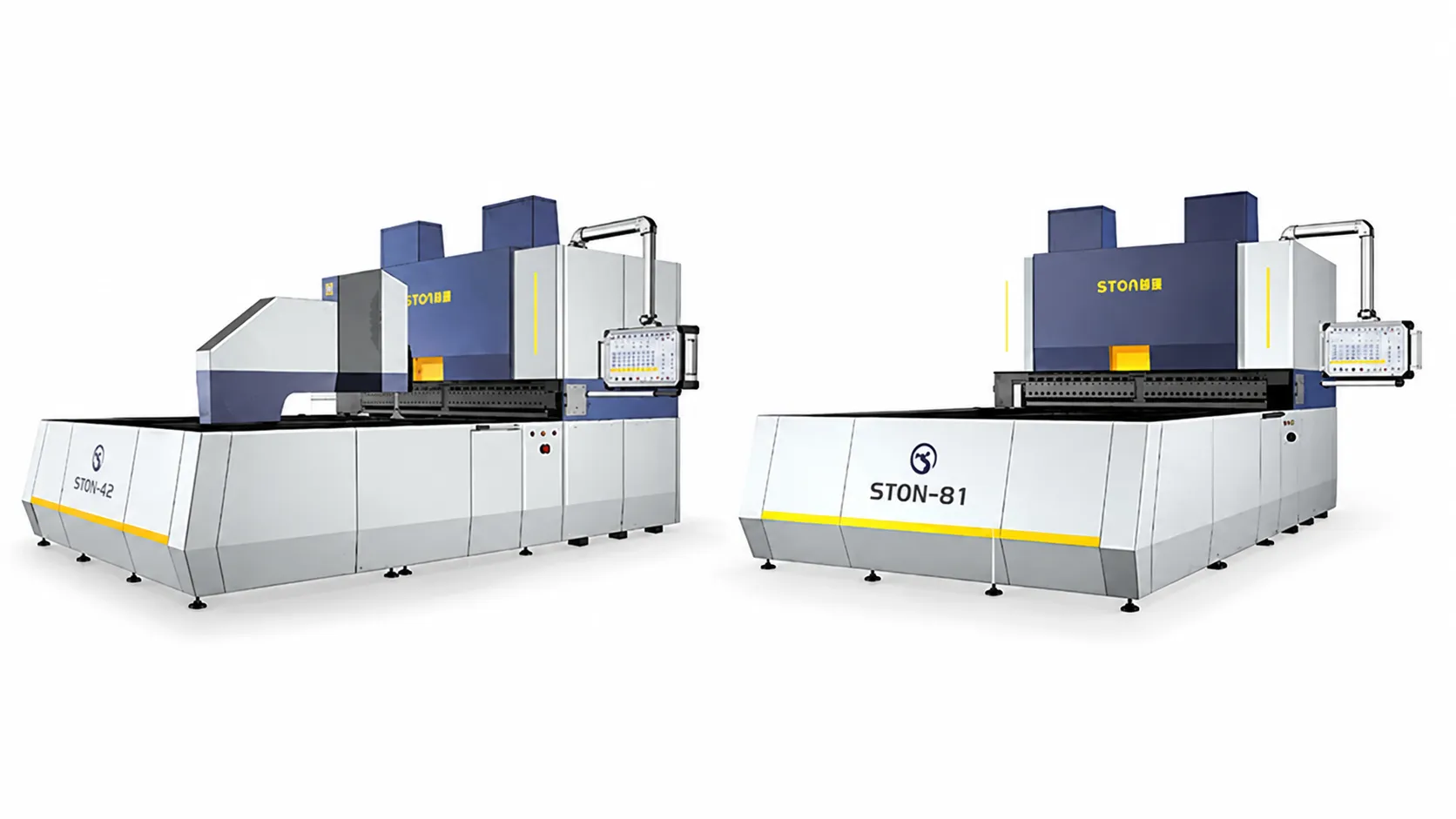
The forming side of this comparison is the STON A2–F2 panel bender series, available in Press Arm and Vacuum (suction cup) configurations. Bending size and thickness limits scale with model:
| 모델 | Max bending size (mm) | Max thickness at full bend | Servo axes |
|---|---|---|---|
| A (1000), welded | 1000 × 1000 | CR 1.5 mm / SS 1.0 mm | 15 |
| B (1400), cast bed | 1400 × 1250 | CR 2.0 mm / SS 1.2 mm | 15 |
| C (2000), cast bed | 2000 × 1500 | CR 2.0 mm / SS 1.2 mm | 15 |
| D (2500), cast bed | 2500 × 1500 | CR 2.0 mm / SS 1.2 mm | 15 |
| D+ (2800), cast bed | 2800 × 1500 | CR 2.0 mm / SS 1.2 mm | 15 |
Every model in this series ships with a native docking port for automatic loading and unloading, so the machine itself doesn’t need to be swapped out when moving from manned operation to gantry-fed or robot-fed operation — only the material-handling layer changes. That’s structurally different from retrofitting a press brake for robotic tending, which typically requires additional squaring tables and re-grip stations bolted on afterward.
For the automation side, STON offers two paths: the Bronte robotic arm for full 6-axis load/unload/flip cycles, and a truss-type gantry system for simpler, repetitive load/unload motion without the flexibility (or cost) of a full robotic arm. Published payload, cycle time, and reach specifications for both units aren’t yet available in STON’s public documentation — before quoting a robotic-cell payback to a customer, confirm these figures directly with engineering rather than estimating from the panel bender’s own throughput.
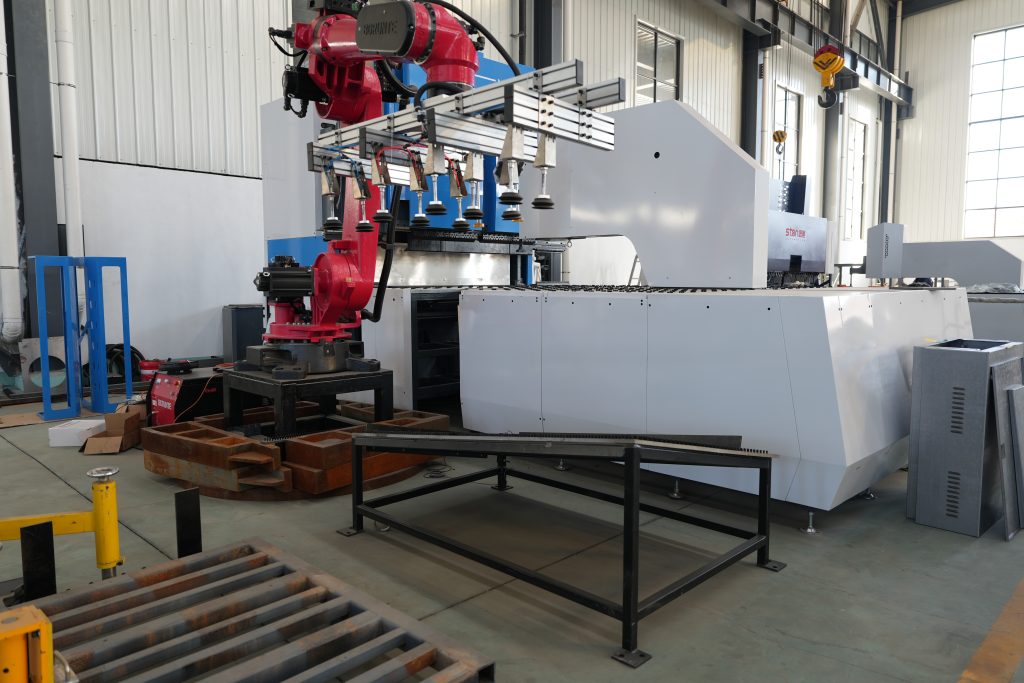
The most common mistake in this decision isn’t underestimating automation — it’s assuming the fullest automation tier is always the right target. A shop running high part-mix variety (short runs, frequent tooling changes, one-off geometries) gets less benefit from a robotic arm than the model above suggests, because changeover time between part families eats into the same availability factor that made the labor savings work. In that profile, a gantry-fed panel bender with an operator managing two or three machines often lands a shorter payback than a fully unmanned cell, simply because the incremental cost jump from gantry to robotic arm isn’t matched by an equivalent jump in usable output when the product mix keeps changing.
The reverse mistake happens too: sticking with a manned brake because “our parts are too varied for automation” without ever running the batch-size threshold calculation. Variety and volume are separate variables. A shop can have twenty SKUs and still hit the automation threshold if each SKU runs in large enough batches with infrequent-enough tooling changes.
Q: What’s a realistic payback period for a robotic bending line?
A: It depends entirely on your labor savings, scrap reduction, and throughput gain relative to system cost — there’s no universal number. Run the formula above with your own inputs rather than relying on a published range.
Q: Does STON publish fixed prices for robotic bending cells?
A: No. Pricing depends on panel bender model, robot or gantry configuration, and site-specific integration requirements. Contact STON for a configuration-specific quote.
Q: Can an existing STON panel bender be upgraded to robotic loading later, or does it need to be ordered that way from the start?
A: The A2–F2 series ships with a native automatic loading/unloading docking port as standard, so a gantry or robotic arm can generally be added after initial installation rather than requiring a different machine purchased upfront. Confirm compatibility with your specific model and configuration with STON engineering.
Q: Is a truss/gantry system cheaper than a robotic arm?
A: Generally yes, because it handles simpler, more repetitive motion paths, but exact pricing isn’t published and should be quoted for your part geometry and batch profile.
Q: How long does it take a new robotic cell to reach full rated speed?
A: Expect a ramp-up period — commonly the first two to six months — while programs, grippers, and part-family tooling are tuned. Building this into a payback calculation, rather than assuming day-one peak output, produces a more realistic timeline.
Q: Does higher part variety always rule out automation?
A: No. Volume and variety are independent factors. High-mix production with large enough batch sizes per SKU can still clear the automation threshold; the changeover time per switch matters more than the number of distinct parts.
Q: What certifications apply to robotic bending cells for EU export?
A: Machinery Directive 2006/42/EC (and its successor Regulation (EU) 2023/1230) and EN ISO 12100 for risk assessment apply to integrated robotic cells sold into the EU, in addition to any machine-specific standards like EN 12622 for the press brake or panel bender component.
Q: What happens to displaced operators in the labor-savings calculation?
A: The formula only produces real savings if headcount is actually reduced or reassigned to other work — not just idled. Confirm with operations whether displaced labor becomes a genuine cost saving or a reassignment before using it in a payback projection.
기존 라인을 업그레이드하든 새 프로젝트를 시작하든 STON은 고객의 생산에 맞는 CNC 솔루션을 맞춤 제작합니다.